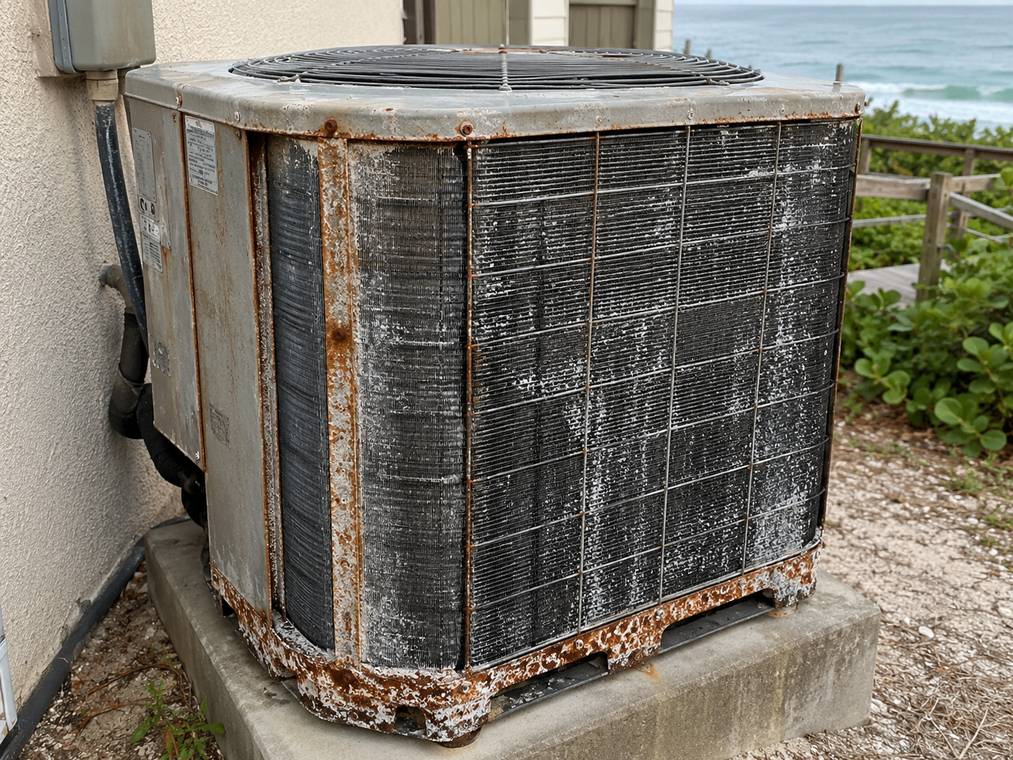
If you own a home on Galveston Island, the Bolivar Peninsula, or anywhere along the bay, you already know the salt air does something to metal. You see it on patio furniture, on door hinges, on the railing leading down to the seawall. What you may not see, at least not until it is too late, is what that same salt air is quietly doing to your outdoor HVAC unit.
We have been keeping homes and businesses comfortable along this stretch of the Texas coast for nearly seventy years. The single biggest factor that decides whether a system lasts five years or fifteen on the Island is not the brand on the box. It is corrosion. Specifically, it is how well a homeowner plans for the salt air before the damage shows up on the outside of the unit.
This guide walks through the HVAC parts most vulnerable to Galveston salt air, the warning signs you can catch before a coil leak or a control board failure, and the steps a Coastal Comfort technician would take to protect your system. Treat it as a checklist for the next time you walk past your condenser.
Why Galveston Salt Air Is So Hard on HVAC Equipment
Coastal air on the upper Texas Gulf Coast carries marine aerosols. Those are tiny droplets and crystals loaded with sodium chloride, magnesium chloride, and sulfate compounds. The salts are hygroscopic, which is a clean way of saying they pull moisture out of the humid Gulf air. That moisture forms a thin electrolyte film on every metal surface it touches, and that film is what drives electrochemical corrosion on coils, fins, fasteners, and electrical terminals.
Three local conditions stack on top of that chemistry and accelerate the damage:
- Distance from tidal water. Homes within roughly 1,000 to 1,500 feet of the Gulf or Galveston Bay sit in the highest salt aerosol zone, and chloride deposition drops sharply as you move inland.
- Heat and humidity. Warm, moist air keeps the salt film wet on the coils for long stretches, which strongly accelerates the anodic and cathodic reactions that pit aluminum and rust steel.
- Onshore wind. Prevailing winds drive salt particles deep into outdoor units, especially condensers that sit on the windward side of the house with no shielding.
Industry corrosion data is blunt about what this combination does. Chloride-driven corrosion in marine atmospheres can run four to eight times faster than in a typical inland setting. A system that should last 12 to 15 years inland routinely fails in 7 to 10 years on Galveston Island. On exposed beachfront and bayfront lots, that drops further to roughly 5 to 8 years without protection.
The HVAC Components Most Vulnerable to Salt Air Corrosion
Not every part of your system corrodes at the same rate. The outdoor condenser takes the brunt of it, and inside that condenser there is a clear hierarchy of what fails first. Knowing the order helps you focus your attention.
1. Aluminum Fins and Condenser Coils
Modern residential condensers use copper tubes with aluminum fins, or all-aluminum microchannel coils. The fins are the first visible casualty.
- Pitting and “white rust.” Chloride ions push past aluminum’s natural oxide layer and create pits and formicary, or “ant nest,” corrosion. The white powdery residue you see on a coastal coil is the byproduct of that attack.
- Fin loss and bent edges. Sections of fins corrode away, bend, or crumble. Once you have measurable fin loss above roughly 15 percent of the fin area, airflow and capacity start dropping in a way you can feel at the supply registers.
- Galvanic corrosion at copper to aluminum joints. Where copper tubes meet aluminum fins or headers, the salt electrolyte film turns the contact into a small battery. The aluminum becomes the sacrificial anode and corrodes preferentially.
- Tube wall thinning and refrigerant leaks. Over months to years, the corrosion progresses from fin surfaces into the tube wall and eventually perforates the refrigerant circuit. That is when a coastal condenser typically gets condemned.
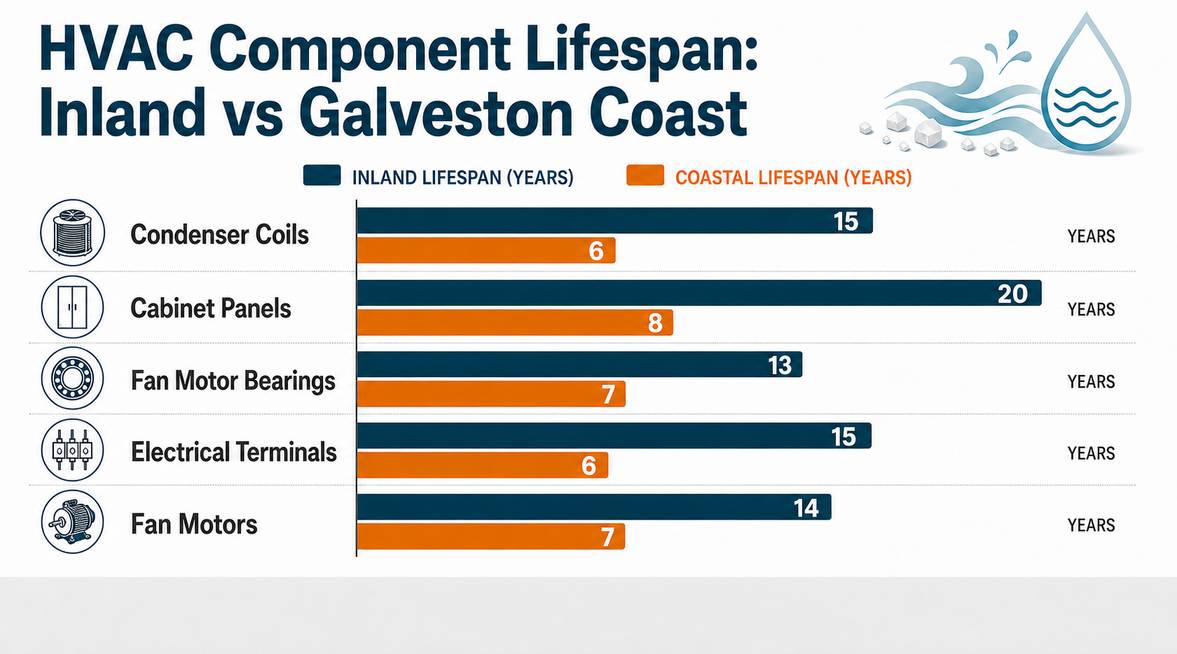
Unprotected condenser coils on Galveston Island commonly fail in 5 to 7 years versus 15-plus years inland. The cooling capacity loss happens long before the coil leaks, which is why we pay attention to performance trends, not just appearance.
2. Cabinet Panels, Fasteners, and Structural Steel
Cabinets, brackets, base pans, and screws on most residential units are galvanized or painted steel. Coastal exposure breaks them down through a predictable sequence.
- Red rust under the paint. Salt water finds a chip, a scratch, or a fastener head and gets under the coating. Once it does, the rust spreads sideways and undermines the finish.
- Seized screws and bolts. Corroded fasteners refuse to come out, which is why a four-hour service call on a five-year-old coastal unit can stretch into a coil-replacement conversation when the access panels will not release.
- Section loss in supports. Brackets and panels thin out over the years. The structural integrity of the unit suffers, and we sometimes find condensers that have started to slump on their pads.
Coastal life for cabinet panels runs about 7 to 10 years versus 20 years inland.
3. Electrical Contacts, Contactors, and Control Boards
Salt damage is not just mechanical. The electrical compartment is where some of the most expensive failures hide.
- Conductive salt film on contactors. Salt particles inside the electrical compartment form a thin conductive film. That film causes surface tracking, which is essentially current finding a path across insulation it should not cross.
- Pitted terminal lugs and relay contacts. Corroded terminals increase resistance, which means heat at the connection. Heat then accelerates the next round of failure.
- PCB corrosion. Solder joints and fine traces on a printed circuit board can be eaten through by a microscopic salt layer. We have seen $200 control boards fail from contamination you cannot see without magnification.
Electrical terminals last roughly 5 to 8 years on the coast versus 15 years inland. The frustrating part is that these failures look like random “the unit just won’t turn on” calls, when they are really the slow result of months of salt deposition inside the control box.
4. Fan Motors and Bearings
Outdoor fan motors live above the coil and inhale every salt particle that gets through. Bearings rust, brushless motor controllers corrode, and fan blades unbalance as buildup forms unevenly. Expect roughly 6 to 8 years of life on the coast versus 12 to 15 inland.
5. Copper Refrigerant Lines and Brazed Joints
Copper is more chloride-resistant than aluminum, but it is not immune. External pitting, corrosion under deteriorated insulation, and galvanic attack at dissimilar-metal transitions all show up on coastal systems. The most common failure mode here is a slow leak at a brazed joint where moisture and salt sat for a long time under flaking pipe insulation.
Early Warning Signs You Can Catch Before the Damage Is Visible
The expensive failures, refrigerant leaks, board burnout, compressor lockout, are downstream of weeks or months of quiet corrosion. The good news is that the early stages leave a paper trail. Watch for these signals.
Performance Trends Before Visible Rust
- Rising electric bills with no change in thermostat behavior. Fouled coils cannot reject heat efficiently. The compressor runs longer and pulls more amps.
- Longer run times to hit setpoint. If a cycle that used to take 20 minutes now takes 35, capacity is already off.
- Reduced airflow at the registers. Bent or missing fins choke the coil before the rust is obvious.
- Higher head pressures during a service call. A technician’s gauges often catch a coastal coil starting to slip before the homeowner does.
Visual Cues on the Outdoor Unit
- White powdery residue on the fins. That is aluminum oxide and chloride byproducts. It is the first visible sign of pitting.
- Streaks of red rust at panel seams, fastener heads, and the base pan. Pay attention to where water collects after a rain.
- Salt crust at the bottom of the cabinet. Salt accumulates at low points. Run your finger across the base pan and check for grit.
- Bubbled or peeling paint. Coating failure means salt is now in direct contact with the steel underneath.
Inside the Electrical Compartment
This is where a tech with a flashlight finds problems that explain the random “the AC just won’t turn on” calls.
- Green or blue powder on copper terminals. Copper sulfate or chloride salt, both indicate corrosion at the connection.
- Discoloration around relay contacts. Heat staining from increased resistance.
- Dust and salt cake on the control board. Even a microscopic film can cause tracking and intermittent faults.
If you spot any of these, do not wait for the unit to fail on the next 95-degree afternoon. The early-stage interventions are inexpensive. The late-stage interventions are coil and condenser replacements.
What to Do Before the Damage Is Visible: The Coastal Comfort Prevention Checklist
If you take nothing else from this guide, take this list. These are the steps we walk through with every Comfort Club member on the Island.
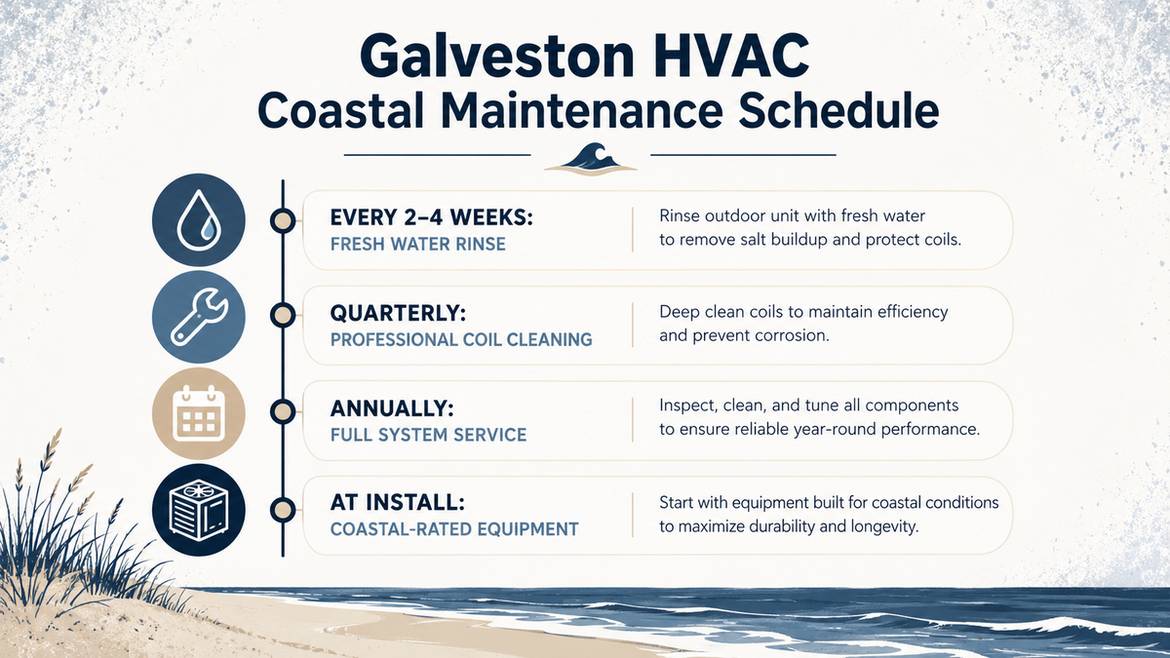
Every 2 to 4 Weeks: Fresh Water Rinse
The single most cost-effective protection is a garden hose. Salt only corrodes metal when it stays on the metal. Rinse the outdoor unit with fresh water at low pressure to flush salt deposits off the fins, the cabinet, and the base pan.
- Turn the disconnect off at the unit first.
- Use a gentle spray, not a pressure washer. Bent fins are a maintenance problem in their own right.
- Spray from top to bottom and from inside out where you can reach.
- Pay attention to the corners of the cabinet where salt cakes accumulate.
- Frequency: every 2 weeks within 1,000 feet of tidal water, every 3 to 4 weeks within the next mile, monthly through the rest of the Island and Bolivar.
Quarterly: Professional Coil Cleaning and Corrosion Inspection
Twice-a-year tune-ups are an inland recommendation. On Galveston Island, plan on four professional visits per year. A coastal-grade quarterly visit covers:
- Detailed coil cleaning with a non-acidic coil cleaner appropriate for coated coils.
- Inspection of cabinet fasteners and panels for under-coating corrosion.
- Electrical compartment check, including contactor surfaces, capacitor terminals, and control board.
- Refrigerant pressure and superheat check to catch capacity loss before it becomes a leak call.
- Fan motor amp draw and bearing check.
- Drain pan and condensate line clearing.
Annually: Full Coastal System Service
In addition to the quarterly work, the annual visit goes deeper.
- Indoor coil inspection and cleaning, including blower wheel.
- Refrigerant charge verification with subcooling and superheat readings.
- Cabinet integrity and seal check, including the electrical compartment gasket.
- Coating touch-up where bare metal has been exposed.
At Installation or Replacement: Build for the Coast
When the time comes to install or replace equipment, the upfront decisions set the ceiling on how long the system can last.
- Choose coastal-rated equipment with factory coil coatings (look for “coastal,” “seacoast,” “marine,” or specific epoxy or phenolic coil-coating language on the spec sheet).
- Specify a marine-finish cabinet rather than bare galvanized steel.
- Use stainless or coated fasteners and corrosion-resistant mounting hardware.
- Set the unit on a polymer or composite pad, not bare concrete that wicks salt.
- Place the condenser on the leeward side of the house when site conditions allow. Use the building itself as a windbreak.
- Maintain three feet of clearance for service and airflow, but add a solid privacy-fence section or salt-tolerant landscaping on the prevailing windward side to cut direct spray.
- Elevate the unit above splash height. On stilted Bolivar homes, that often means raising the pad and using non-corroding strap downs.
Aftermarket Options for Existing Equipment
If you already own a standard inland-grade unit, you have options that fall well short of replacement.
- Aftermarket coil coatings (epoxy, phenolic, polyurethane-aluminum systems) applied to a clean coil can add multiple years of life. Typical cost is in the low hundreds of dollars per coil, well below the cost of even one early coil replacement.
- Cabinet touch-up paint rated for marine environments on rust spots and fastener heads.
- Stainless fastener swap-out at the next service visit.
- Compartment sealing improvements to keep more salt out of the electrical box.
The Cost Math: Why Coastal Protection Pays for Itself
Homeowners sometimes balk at the upfront premium for coastal equipment or quarterly maintenance. The numbers work out in favor of protection in almost every case.
Equipment Premium
Coastal-rated outdoor units with factory corrosion protection typically cost 10 to 20 percent more than standard models. On a Galveston residential condenser replacement that runs roughly $3,500 to $6,000 installed, that translates to $350 to $1,200 extra at the time of purchase.
Maintenance Premium
A coastal-grade quarterly maintenance plan typically runs $400 to $600 per year for a standard residential system, compared with $150 to $250 for a one-tune-up-per-year inland plan.
What You Get for the Premium
- Coastal-rated equipment with proper maintenance can push expected life from 7 to 8 years back up to 12 to 15 years.
- Aftermarket coil coatings can add up to 5 extra years of coil life on existing equipment.
- Quarterly fresh-water rinses alone can add several years to outdoor unit service.
- The avoided cost of one early condenser replacement (often $4,000 to $6,000) covers many years of premium maintenance.
The simplest way to think about it: every dollar spent on protection on the front end is usually two to four dollars not spent on premature replacement on the back end.
Where Coastal Comfort Fits In
We are based on Galveston’s West End, which puts us on your side of the Island when you call. Nearly seventy years of combined HVAC and refrigeration experience on the Texas coast has taught us where corrosion shows up first, which neighborhoods need the tightest maintenance intervals, and which equipment platforms hold up best in salt-laden air.
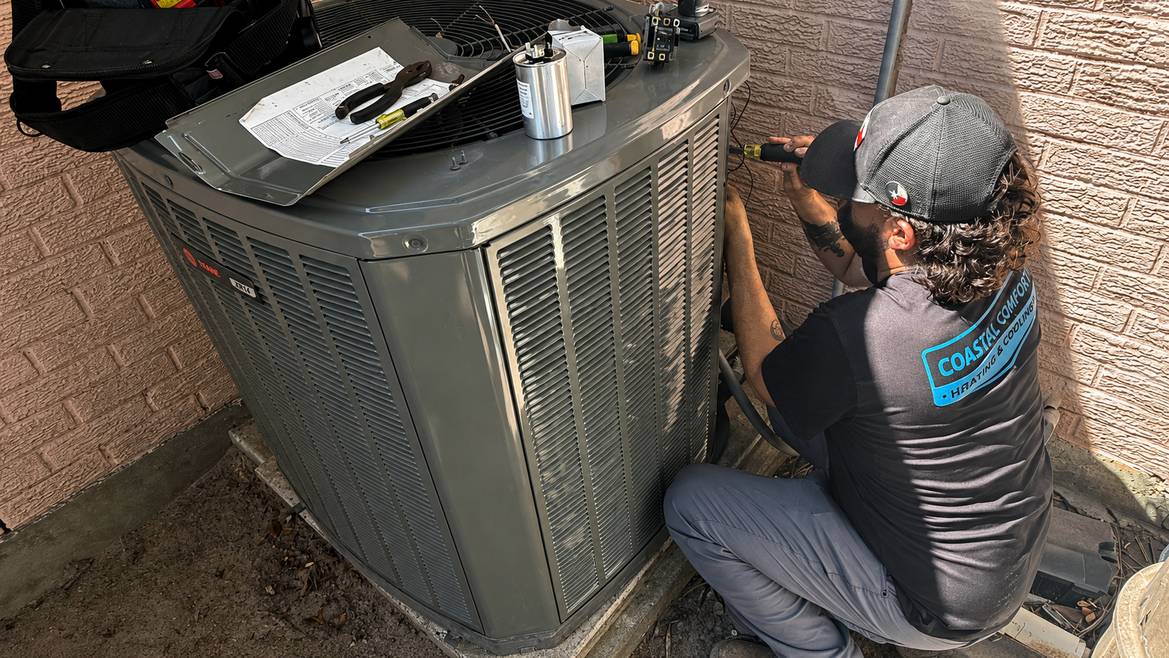
- For ongoing protection, our Comfort Club routine maintenance plans handle the quarterly visits and document corrosion trends visit over visit.
- If you are seeing performance loss already, our HVAC repair services team can diagnose whether you are looking at a coil rinse, a coating touch-up, or a real replacement conversation.
- When replacement is the right answer, our HVAC installation team specifies coastal-grade equipment from the start.
- For systems that have already failed on a hot day, 24/7 emergency dispatch gets a tech to your door, including on the West End and Tiki Island.
Catch the Damage Before It Costs You a Condenser
Salt air on Galveston Island is not optional. It comes with the view. What is optional is whether you let it quietly cut your HVAC service life in half, or whether you build a routine that holds equipment life close to what an inland homeowner gets.
If you would like an honest look at what your outdoor unit is up against, a Coastal Comfort technician can walk through the corrosion checklist on your specific home, document where you are today, and put together a maintenance cadence that matches your exposure zone.
Frequently Asked Questions
How fast does salt air actually corrode an HVAC unit in Galveston?
Chloride-driven corrosion runs four to eight times faster in marine atmospheres than in typical inland conditions. On Galveston Island, that means systems that should last 12 to 15 years often fail in 7 to 10 years without protection. Within 1,000 to 1,500 feet of tidal water, beachfront and bayfront homes can see condensers fail in as little as 5 to 8 years.
Is rinsing my outdoor unit with a garden hose actually worth it?
Yes. Salt only corrodes metal while it stays on the metal. A low-pressure freshwater rinse every 2 to 4 weeks is the single most cost-effective protection on Galveston Island. Always cut power at the disconnect before rinsing, use a gentle spray to avoid bending fins, and focus on the corners of the cabinet where salt cakes accumulate.
Should I buy a coastal-rated AC unit or just save the money on a standard model?
If your home is anywhere on the Island, Bolivar Peninsula, Tiki Island, or within roughly a mile of Galveston Bay, coastal-rated equipment usually pays for itself. The 10 to 20 percent equipment premium is small compared to the cost of replacing a standard unit five to seven years earlier than the coastal-rated equivalent.
Can I add corrosion protection to my existing HVAC system?
Yes. Aftermarket coil coatings (epoxy, phenolic, or polyurethane-aluminum systems) can be applied to a clean existing coil and typically add multiple years of life. Cabinet rust spots can be touched up with marine-rated paint, and stainless or coated fasteners can be substituted during routine service. The cost is in the low hundreds, well below a coil replacement.
What are the earliest warning signs of salt-air corrosion before I can see rust?
Rising electric bills with no thermostat change, longer run times to hit setpoint, and reduced airflow at the registers all show up before visible rust. On the unit itself, white powdery residue on the aluminum fins is the first visible signal, well before any red rust appears at panel seams or fastener heads.
How often should HVAC maintenance be scheduled in Galveston versus inland?
The standard inland recommendation is one to two tune-ups per year. On Galveston Island and the Bolivar Peninsula, plan on quarterly professional visits along with a homeowner freshwater rinse every 2 to 4 weeks. Inland Galveston County zip codes can usually run on a tightened version of the standard inland schedule with quarterly coil rinses added.