If you run a restaurant, bar, hotel, or seafood market here on the island, your ice machine is one of the hardest working pieces of equipment in the building. It runs all day, every day, and on the Texas Gulf Coast it has one very specific enemy: hard water.
At Coastal Comfort, we have been servicing ice machines across Galveston County for years, and we see the same story over and over. A machine that was producing clear, beautiful cubes on day one starts making cloudy, clumpy, half-frozen ice 18 months later. The owner blames the machine. The real culprit is almost always the water.
In this guide, we walk through exactly what hard water does to commercial and residential ice machines over time, why Galveston water is so tough on this equipment, the warning signs to watch for, and what you can do to protect your investment.
Why Galveston Water Is So Hard on Ice Machines
Galveston’s municipal water tests at roughly 14.8 grains per gallon (gpg) of hardness, mostly from calcium carbonate. On the standard water hardness scale, anything above 10 gpg is classified as “very hard.”
For context, most ice machine manufacturers (Hoshizaki, Manitowoc, Scotsman, Ice-O-Matic) recommend feed water in the 4 to 7 gpg range. Galveston tap water is roughly double to triple what these machines were designed to handle.
That gap matters because ice machines concentrate minerals as they freeze. When water freezes on the evaporator plate, mostly pure ice forms and the dissolved calcium and magnesium get rejected back into the remaining liquid. That liquid recirculates and gets more mineral-dense with every cycle. The result is calcium carbonate (limescale) plating itself onto every cold surface inside the machine.
In our service calls, we have seen deposits that the local water industry literally describes as “concrete-like” sealing off distribution tubes, fouling probes, and turning shiny stainless evaporators into rough, chalky surfaces.
Quick insight: Ice machines in Galveston need to be treated like equipment running in one of the harshest water environments in Texas. The maintenance intervals you would use in a soft-water city are not enough here.
What Hard Water Does to an Ice Machine, Step by Step
Hard water damage does not happen overnight. It is a slow, compounding process that quietly steals output and efficiency before it ever becomes a visible problem.
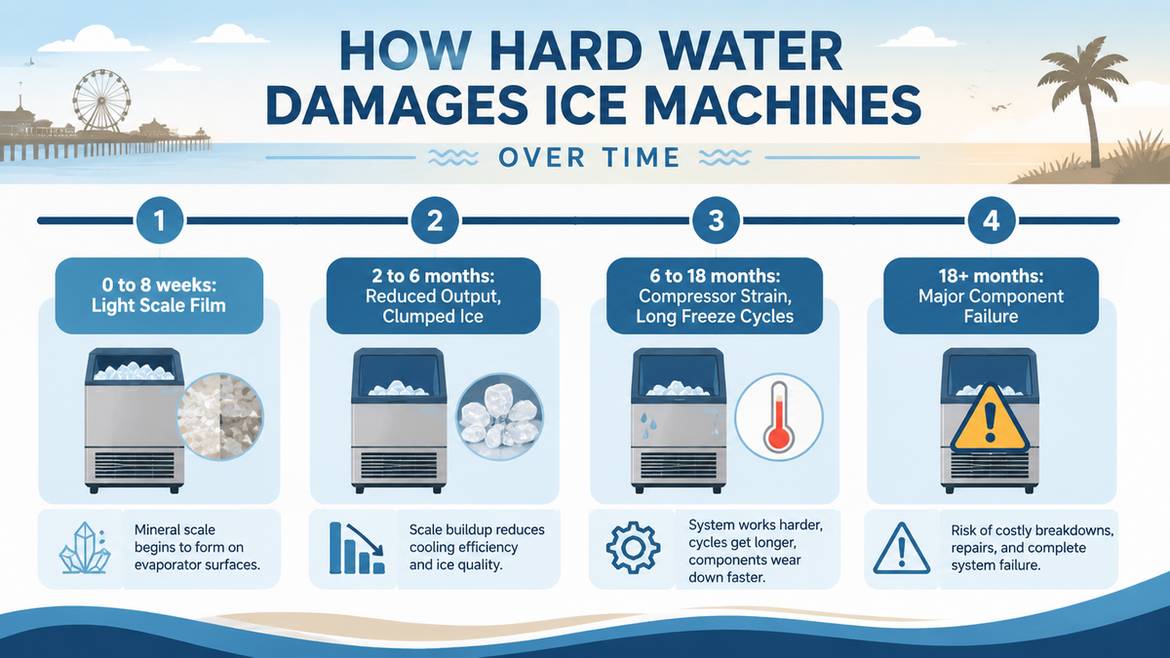
The First 4 to 8 Weeks: The Quiet Phase
A thin film of scale starts forming on the evaporator plate, in the water trough, and around water level sensors. You probably will not notice it yet. Ice cubes might look slightly less clear, and there may be a few faint white spots inside the bin.
Performance is still close to nameplate. The machine is just starting to lose the fight.
Months 2 to 6: Output Drops
Now scale begins clogging water distribution holes and spray nozzles, so water no longer hits the evaporator evenly. Cubes start coming out smaller, fused together in clumps, or with hollow centers. Freeze cycles get longer because the scale acts as an insulator and slows heat transfer.
This is the stage where owners start saying things like “We are running out of ice during the lunch rush.” Output is often down 10 to 20 percent at this point, and energy bills creep up because the machine is running longer per harvest.
Months 6 to 18: Real Damage
Without descaling, scale is now thick enough to insulate the evaporator significantly. The compressor runs hotter, longer, and at higher discharge pressures because it cannot reject heat the way the manufacturer designed it to. Long freeze cycles trigger error codes. Probes give false readings. Sludge builds in the drain.
By this point, ice quality is bad enough that customers notice. Drinks taste off. Cubes are cloudy or fused. And the machine is leaking money in three directions at once: lost ice production, higher electric bills, and the wear and tear quietly racking up on the compressor.
18 Months Plus: Catastrophic Failures
This is where service calls turn into replacements. Compressors fail prematurely. Water valves seize. Sensors stop responding. We have opened machines at this stage and pulled out chunks of mineral the size of pebbles. The repair bill often gets close to the cost of a new unit, and on a busy weekend that decision has to be made fast.
Documented Effects on Performance
Pulling from industry data and our own field experience, here is what untreated hard water actually does to a commercial ice machine over time:
- Ice production drops by 10 to 20 percent within a few months as flow restrictions and poor heat transfer take hold. We have seen 300-pound-per-day machines effectively delivering closer to 240 pounds in peak season.
- Energy use rises by roughly 5 to 15 percent because the compressor has to work longer per pound of ice. On a busy Galveston restaurant running ice production 18 hours a day, that adds up quickly.
- Compressor life shortens because higher discharge temperatures degrade compressor oil, and frequent fault-driven start/stop cycles stress the windings and contactors.
- Ice quality degrades: cloudy cubes, white flakes, hollow centers, off-tastes, and clumping. For a bar or restaurant, this is a customer-facing problem.
- Hygiene suffers because scale provides rough surfaces where biofilm and slime can take hold. Health inspections do not look kindly on either.
How Each Major Brand Handles Hard Water
Most of the commercial machines we service across the island are one of four brands. Each has its own quirks when it comes to Galveston water:
- Hoshizaki: Prefers hardness in the 4 to 6 gpg range and explicitly recommends phosphate-based scale inhibition over straight softeners alone. High sodium from over-softening can affect ice quality, so blended treatment is usually the right call.
- Manitowoc: Designed for roughly 2 to 6 gpg as ideal, with treatment strongly recommended above 6 gpg. Avoid extremely soft water with high chlorides since that can corrode stainless and copper components.
- Scotsman: Recommends 4 to 7 gpg, with filtration and scale control treated as standard practice on every install. Galveston water sits well outside their preferred band.
- Ice-O-Matic: A bit more tolerant at 4 to 10 gpg, but at 14.8 gpg, softening or scale-control is still necessary.
We service all four brands as part of our commercial ice machine repair work, and the pattern is consistent: untreated machines do not last in Galveston.
Warning Signs of Mineral Buildup
If you are reading this and wondering whether your machine is already in trouble, here are the signs we tell our commercial customers to watch for:
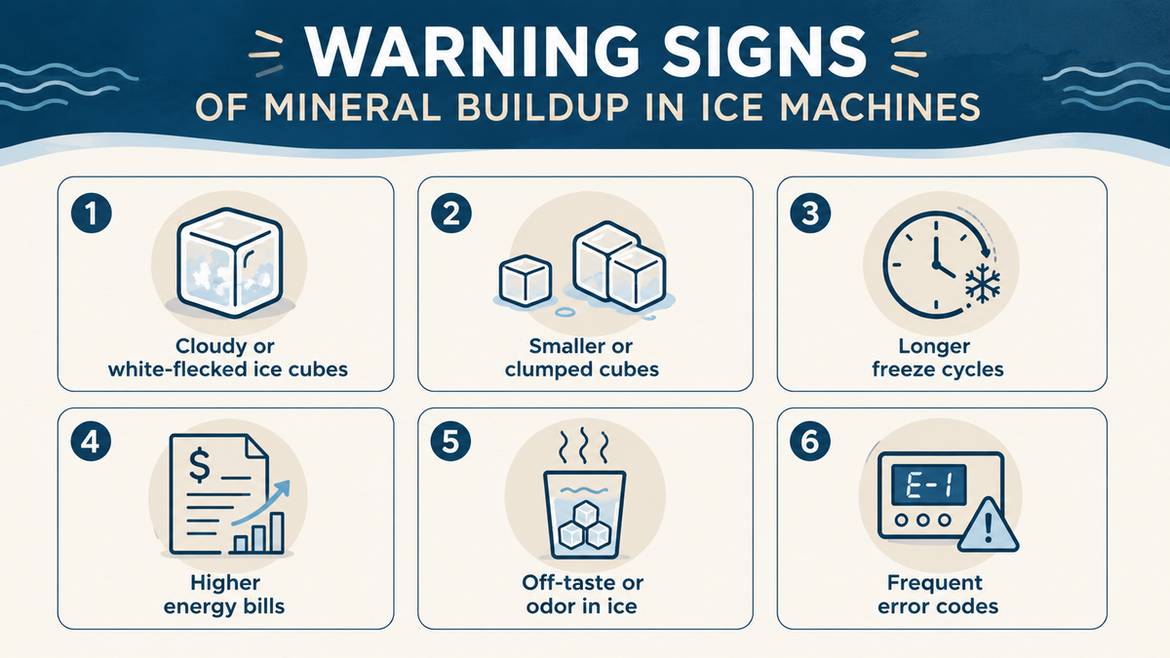
- Cloudy or white-flecked cubes. Clear ice means the evaporator is shedding minerals correctly. Cloudy ice means minerals are getting trapped in the cubes.
- Smaller or fused cubes. Uneven water distribution on the evaporator from clogged nozzles.
- Longer freeze cycles or “long freeze” error codes. Scale insulating the evaporator.
- Visible white film or chalky residue on plastic, metal, or sensors inside the machine.
- Off-taste or odor in the ice, sometimes carried into drinks.
- Higher electric bills without a clear reason. Scale is one of the most common silent causes.
- Output that drops in peak season even though the machine is rated for that volume.
If you are seeing two or more of these, the machine almost certainly needs to be descaled and inspected by a technician.
Preventive Maintenance Schedule for Galveston Ice Machines
Generic manufacturer guidance usually says “clean twice a year.” That guidance is written for soft-water markets. For Galveston-level hardness, here is what we actually recommend.
Daily, by your staff:
- Visually check the ice. Pull anything that looks discolored, smells off, or is fused into clumps.
- Wipe down the bin door and exterior with a food-safe sanitizer.
- Make sure the air around the machine is clear of grease and dust so the condenser can breathe.
Weekly:
- Empty the bin completely at least once a week. Sanitize the interior walls and baffles. Let everything dry before refilling.
- Look for the early scale signs above (white spots near the waterline, slight haze on cubes).
Monthly:
- Clean the air filter and inspect the condenser coil. On the island, salt air and kitchen grease form a film that strangles airflow surprisingly fast.
- Check the water filter pressure. If it is dropping, the cartridge is loaded up and needs to be replaced.
Every 4 to 8 weeks (the Galveston interval):
- Run a full descaling and sanitizing cycle using the cleaner specified by your machine’s manufacturer. Generic descalers can void warranties on some units.
Professional service:
- High-volume commercial machines (busy restaurants, bars, hotels): every 3 months, sometimes every 6 to 8 weeks in peak season.
- Lower-volume commercial (office break rooms, small cafes): every 4 months.
- Residential undercounter units: every 4 to 6 months.
This is the schedule we build into our routine maintenance plans for businesses across the island. Skipping intervals always costs more than keeping them.
Water Filtration Options That Actually Work
There is no fix for hard water that does not start with treating the water itself. For ice machines in Galveston, we usually recommend one of three setups depending on the application:
1. Point-of-use ice machine filtration cartridge (minimum).
A sediment prefilter, a carbon block for chlorine and odor, and an integrated polyphosphate scale inhibitor. These are the cheapest option and they help, but at 14.8 gpg they are working hard. Plan on changing cartridges every 6 months at most, sometimes every 3 to 4 months in heavy use.
2. Whole-building softener plus point-of-use filtration.
For restaurants, hotels, seafood markets, and any business with multiple scale-sensitive appliances (ice machines, tankless water heaters, dishwashers, commercial laundry), a properly sized ion-exchange softener upstream takes the load off every appliance in the building. A dedicated cartridge at the ice machine polishes taste and removes any remaining particulates.
3. Reverse osmosis with blending.
For premium clear ice (think craft cocktail bars or specialty hotels) or extremely hard supplies, an RO system with a blending valve gives you near-perfect feed water with a controlled amount of hardness added back to keep the machine happy. This is the gold standard and the most expensive of the three.
Which one is right depends on your volume, your budget, and how visible the ice is to your customers. Our commercial HVAC team can size a system based on your actual water test and ice demand.
What This Costs You If You Ignore It
A few rough numbers we have seen on real Galveston service calls:
- A 500-pound-per-day machine losing 15 percent capacity is effectively a 425-pound machine. On a busy weekend, that is the difference between staying open and running to the gas station for bagged ice.
- A scale-fouled compressor running 10 to 15 percent harder over a 5-year life is paying a measurable energy penalty every month, plus a shorter replacement cycle.
- A compressor replacement on a mid-size commercial ice machine runs into the thousands, and the lead time for parts on Manitowoc and Hoshizaki units has not been short in recent years.
Compare that to a quarterly professional descaling plus a proper filtration setup, and the math is not close.
Plan Ahead With Coastal Comfort
Hard water in Galveston is not going away. The geology is what it is, and the city’s water has been hard for as long as people have been pulling it from the tap. The good news is that mineral buildup in ice machines is one of the most preventable equipment problems we see.
At Coastal Comfort, we service every major commercial ice machine brand across Galveston Island, Tiki Island, Santa Fe, and the surrounding bay area. We can pull a unit apart, descale it properly, sanitize the water path, replace fouled filters, and put together a maintenance schedule that actually fits the water you are working with.
If your ice machine is making smaller cubes than it used to, running longer cycles, or just not keeping up the way it did last summer, reach out through our contact page. Same-day service is available, and we are on call 24/7 for emergency repairs through our emergency HVAC line when a machine goes down in the middle of service.

Frequently Asked Questions
How often should a commercial ice machine in Galveston be professionally serviced?
At Galveston’s water hardness (~14.8 gpg), most high-volume commercial machines need professional service every 3 months, and sometimes every 6 to 8 weeks during peak summer demand. Lower-volume units can usually go 4 months between visits. Standard “twice a year” guidance is not enough here.
Can hard water really damage an ice machine, or is descaling enough?
Hard water can absolutely damage a machine if scale is allowed to accumulate. Descaling removes scale, but it does not stop new scale from forming. Long-term protection requires both regular descaling and water treatment (a softener, scale-inhibiting filter cartridge, or reverse osmosis system) to slow buildup at the source.
How do you know if mineral buildup is the problem versus a mechanical failure?
The clearest signs of mineral buildup are cloudy or fused ice, smaller cubes, longer freeze cycles, and visible white scale inside the machine. Pure mechanical failures usually show up as hard error codes, no production at all, leaks, or unusual noises. Many cases are a mix of the two: scale stresses the system until a mechanical component fails.
Are home ice makers affected by Galveston hard water the same way commercial ones are?
Yes, although the timeline is slower because home units produce far less ice and cycle less often. Residential undercounter and countertop ice makers in Galveston should be descaled every 4 to 8 weeks and professionally serviced 2 to 3 times per year to avoid the same scale-related problems on a smaller scale.
Will a whole-house water softener fix the ice machine problem on its own?
A properly sized softener handles most of the scale problem, but it leaves the water with higher sodium content, which some manufacturers (especially Hoshizaki) discourage. The best setup is usually a softener for the building plus a dedicated point-of-use filter at the ice machine to balance the chemistry and remove chlorine and sediment.
How long does descaling actually take and does the machine have to be shut down?
A standard professional descaling on a commercial cube machine takes about 1 to 2 hours, and yes, the machine has to be offline for the cleaning cycle. We typically schedule service for early morning, slow days, or after closing to minimize the impact on operations.