Your AC has that look. Maybe it is making a new sound, running longer than it used to, or asking for its second repair this summer. And now the big question is on the table: do you fix it one more time, or is it time for a new system?
At Coastal Comfort, we get this call all the time from homeowners across Galveston Island, Tiki Island, and the mainland side of the county. The honest answer is that repair vs. replace is rarely one size fits all, especially here on the coast. Salt air, humidity, and long cooling seasons change the math in ways an inland guide will not tell you.
This is our simple, no pressure guide to making the call. We will walk through the age of your system, the cost rules our techs actually use, and the coastal clues that lean one way or the other. By the end, you will know exactly what to ask, what to expect, and when it is worth calling us out for a second look.
Why Galveston Changes the Repair vs. Replace Math
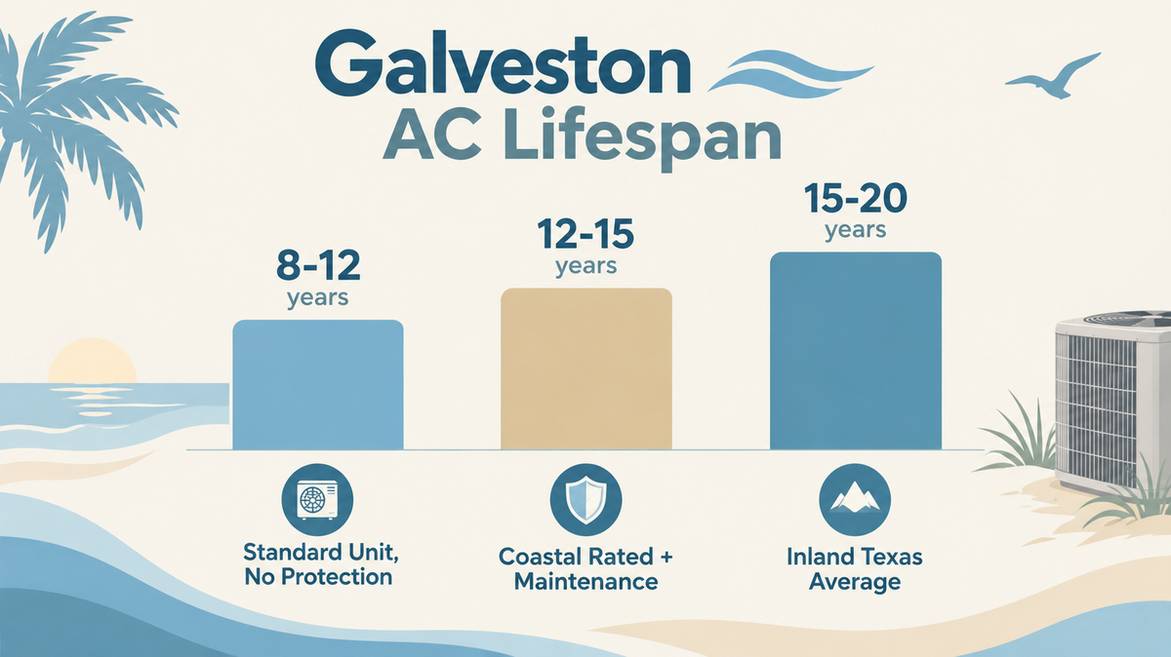
If you have read a national guide on AC lifespan, you have probably seen the classic 15 to 20 year number. That range is real. It is just not our range.
Here is what we see day to day along the Texas coast:
- Standard equipment on Galveston Island typically lasts about 8 to 12 years, not 15 to 20.
- Coastal rated units with strong maintenance can push into the 12 to 15 year range, sometimes longer.
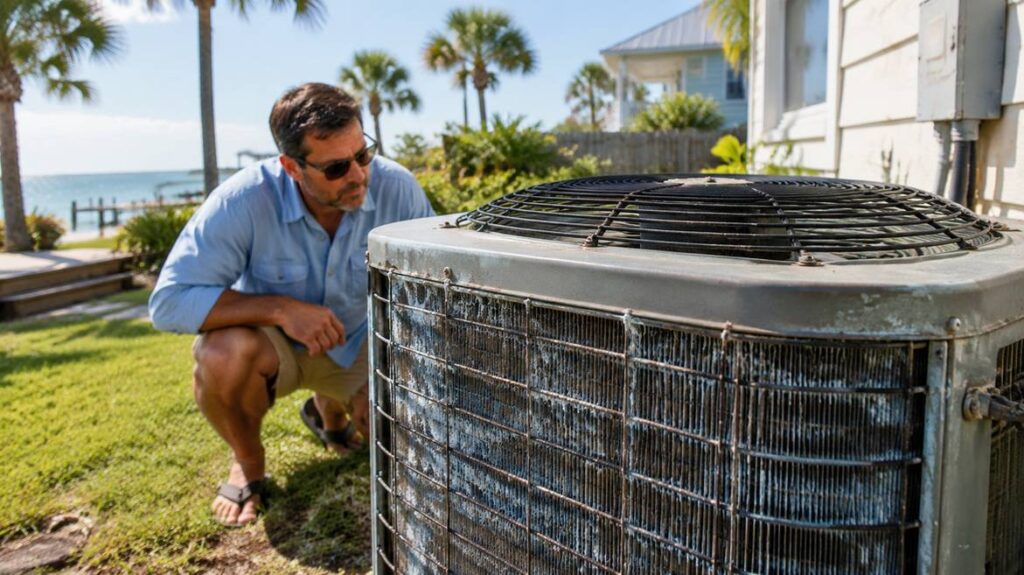
- Outdoor coil corrosion is the single most common issue we diagnose on the island.
The reason is a mix of three coastal forces working on your system every day:
- Salt air carries fine salt particulates that eat away at aluminum fins, copper lines, and electrical contactors.
- High humidity, often above 90 percent, keeps components wet between storms and speeds up corrosion.
- Long cooling seasons mean your compressor runs more hours per year than a system in Dallas or Austin.
Put simply, an 8 year old AC on Galveston Island can have the wear of a 12 year old unit inland. That is why we treat any repair vs. replace question here through a coastal lens.
Step 1: Start With the Age of Your System
Age is the first number to check, because it sets the frame for every other decision. If you are not sure how old your unit is, take a photo of the data plate on the outdoor condenser and we can help you decode the serial number.
Here is how we generally think about age bands in Galveston:
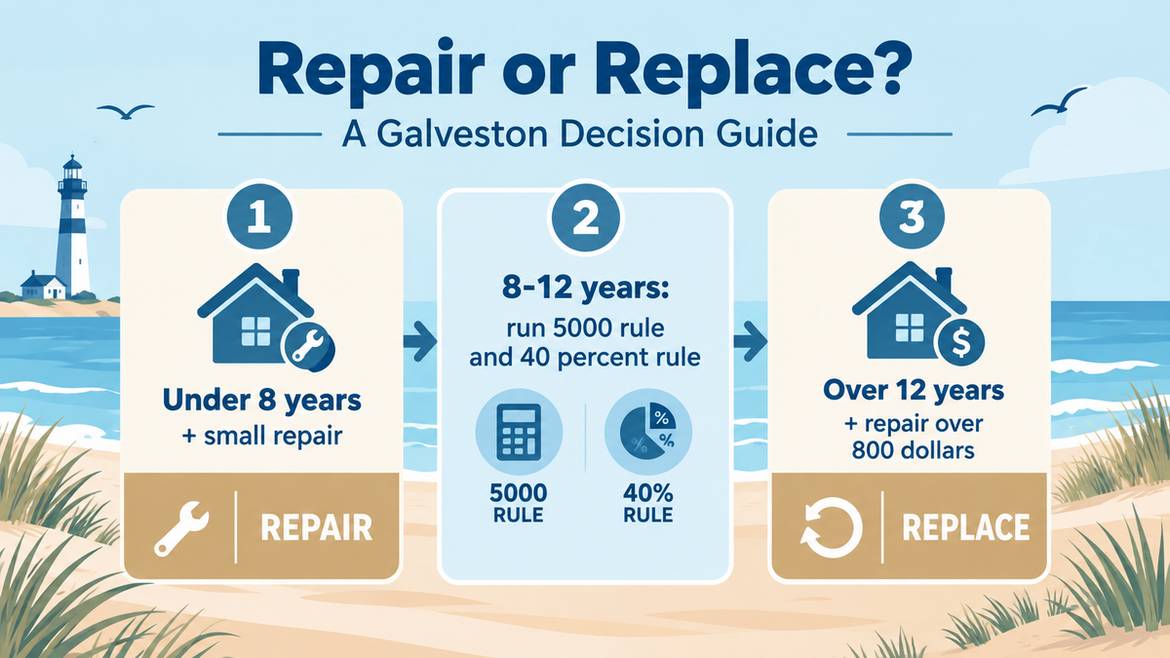
- Under 8 years: You are inside the normal service life. If the issue is isolated and the repair cost is modest, repair almost always wins.
- 8 to 12 years: You are entering the tail end of typical coastal life for a standard system. This is the zone where cost rules matter most.
- 12 years and up: You are near or past practical end of life for most non coastal rated units. Even a moderate repair is worth weighing against a new install.
A well cared for, coastal rated system in the 8 to 12 year range can absolutely be worth repairing. A neglected, salt beaten unit at the same age might not be. This is where an honest, in person look matters more than a chart.
Step 2: Run the Money Rules
Once you know the age, run the numbers. HVAC pros nationally use two simple rules, and we use a coastal version of both here in Galveston.
The $5,000 Rule
Multiply the age of your unit (in years) by the repair estimate (in dollars).
- If age x repair cost is under $5,000, repair is usually reasonable.
- If age x repair cost is over $5,000, replacement is usually the smarter long term move.
Example: a 9 year old unit with a $650 repair works out to 5,850. That is over the line, and on a system already deep into coastal service life, we would talk seriously about replacement.
The 40 Percent Coastal Rule
Compare the repair cost to the cost of a comparable new system.
- If the repair is under 30 percent of a new system and the unit is under 10 years old, repair usually wins.
- If the repair is over 40 percent of a new system and the unit is over 8 years old, replacement usually wins in Galveston conditions.
- If the repair is over 50 percent of a new system on any unit, replacement almost always wins.
Notice how we use 40 percent here instead of the 50 percent rule used inland. That five to ten percent shift reflects the shorter useful life we see near the coast, so you are not spending big on a unit that only has a couple of good summers left.
A Galveston Specific Trigger
There is one more rule of thumb we use for older systems: if your unit is over 12 years old and any single repair is $800 or more, treat it as a real replacement conversation. Not automatic, but real. Once you factor in the next likely failure and the efficiency gain of new equipment, replacement often wins on a five year cost basis.
Repairs That Usually Point to “Fix It”
Not every AC issue is a warning sign. Some are just normal wear on a system that still has years of good life left. If your unit is under 8 to 10 years old, and any of these are the problem, repair is almost always the right call.
- Capacitor or contactor failure: Small, inexpensive parts that fail on a normal schedule.
- Bad thermostat or thermostat wiring: Often a quick fix that has nothing to do with the AC itself.
- Clogged condensate drain: Common in humid climates and usually resolved in one visit.
- Dirty coils or filter: A maintenance issue, not an equipment failure.
- Blower motor issues (minor): Bearings, small parts, or run capacitors on younger motors.
On systems in this age band, we almost always recommend fixing the issue, cleaning things up, and getting you back to cool with minimal fuss. If you want to protect that repair investment, this is also a great time to talk about our routine maintenance and check ups, which are built specifically for coastal equipment.
💡 Local tip: In Galveston, we recommend two maintenance visits per year, one in spring before cooling season and one in fall before heat. That cadence is more aggressive than inland guides suggest, but it is the single biggest lever you have on coastal lifespan.
Repairs That Usually Point to “Replace It”
Some repairs are red flags, especially on older or salt exposed systems. If your tech is quoting one of these, the math often tips toward replacement fast.
- Compressor failure or imminent failure: The compressor is the single most expensive part of the system. On any unit past mid life, replacing the compressor rarely pencils out.
- Evaporator or condenser coil replacement: Especially with visible salt corrosion, a new coil is a major spend on a system that may not have much life left.
- Major refrigerant leak: Small leaks can be repaired. Large or multiple leaks, especially in an aging coil, usually signal it is time to move on.
- R-22 refrigerant systems needing a major repair: R-22 is phased out and expensive. On these systems, we almost always recommend upgrading rather than chasing the leak.
- Widespread visible corrosion: Crumbling coil fins, rusted cabinet, corroded electrical connections, or heavy pitting on copper lines.
On any of these, we will walk you through the numbers carefully. If a repair will only buy you one more summer on an old unit, we would rather have that conversation upfront than see you back in July.
Signs That Have Nothing to Do With the Repair Bill
Sometimes the repair itself is not what tips the scale. It is what has been happening around it. If you are nodding along to two or more of these, replacement deserves a serious look regardless of what today’s specific repair costs.
- Rising summer energy bills at the same thermostat settings for two or three years running.
- Rooms that never quite cool, especially over the garage or on the west side of the house.
- Persistent clamminess or humidity indoors, even when the AC is running.
- Long run times with only modest temperature drops.
- Two or more major repairs in the past two or three summers.
- Visible rust and corrosion on the outdoor unit that keeps coming back after cleanings.
- The house cannot recover after a hurricane season or power outage the way it used to.
Modern coastal rated equipment with proper humidity control can flat out feel different in a Galveston home. Better dehumidification, quieter operation, and lower monthly bills often show up together.
Our Simple Decision Framework
Here is the quick version we walk homeowners through on the phone before we even show up:
- Check the age. Under 8 years, lean repair. 8 to 12 years, run the cost rules. Over 12 years, be honest about lifespan.
- Identify the failure. Minor part or maintenance issue means repair. Compressor, coil, major leak, or R-22 issue means replacement is on the table.
- Run the $5,000 rule. Age x repair cost. Under 5,000 leans repair. Over 5,000 leans replacement.
- Run the 40 percent rule. Repair as a share of new system. Under 30 percent leans repair. Over 40 percent leans replacement on older units.
- Look at corrosion and comfort. Heavy rust, humidity trouble, or hot rooms tip the scale toward replacement.
- Check the pattern. Two or more big repairs in two or three years is a strong replacement signal.
- Get a written quote for both options. A real like for like comparison is the only way to make this call with confidence.
If you want us to walk through this with you on a specific system, that is exactly what our diagnostic visit is for. There is a flat $95 diagnostic fee, and you get a clear written recommendation either way.
What Replacement Actually Looks Like in Galveston
If replacement is the answer, the good news is that today’s coastal ready equipment is a huge step forward. Higher efficiency, better humidity control, and components designed to hold up in salt air.
A few things we typically recommend for Galveston homes:
- Coastal rated condenser coils with protective coatings that resist salt corrosion.
- Correctly sized equipment based on a real load calculation, not just the size of your old unit.
- Ductwork inspection during the install, because leaky ducts can undo the benefits of a new system fast.
- A maintenance plan to protect the investment through Galveston summers.
We are Trane authorized and we install a range of systems that fit different budgets and different priorities. If cost is a concern, we work with Wisetack to offer financing up to $65,000 with a prequalification that does not affect your credit score.
If you are on the island specifically, our Galveston Island HVAC service page has more detail on how we handle coastal installs. And if this decision came up because the AC is out right now, we run 24/7 emergency HVAC service across Galveston County.
When Not to Wait
If your AC has stopped cooling in the middle of a Galveston July, do not sit with the repair vs. replace decision for a week. Get a diagnostic visit on the calendar, get real numbers, and then decide.
Waiting on a struggling unit tends to make the choice for you in the worst way. A limping compressor eventually fails outright. A slow refrigerant leak eventually becomes a big one. And a home that stays humid and warm for days is not just uncomfortable, it can invite mold and damage to floors, cabinets, and electronics.
At Coastal Comfort, we would rather help you make a calm decision now than a rushed one later. That is why we quote both options in writing when the situation calls for it, and why we are honest when a repair really is the smart choice.
Ready to Get a Straight Answer?
Repair or replace is one of the bigger home decisions a Galveston homeowner faces. It should not feel like guesswork.
At Coastal Comfort, we have spent decades keeping homes and businesses cool along the Texas coast, and we treat every repair vs. replace call the same way: honest diagnostic, clear numbers, and a written recommendation you can actually use.

Frequently Asked Questions
What is the $5,000 rule for AC?
The $5,000 rule is a simple way to weigh a repair. Multiply the age of your unit in years by the repair estimate in dollars. If the total is over 5,000, replacement is usually the better long term investment. If it is under 5,000, the repair is often worth doing, especially on a younger system.
Is it better to repair or replace an AC unit in Galveston?
It depends on age, repair cost, and condition. On the Texas coast, standard AC units usually last 8 to 12 years, so we lean toward repair on units under 8 years old and toward replacement on units over 12. In between, cost rules and corrosion levels decide the case.
What is the life expectancy of an AC unit in Texas?
Inland Texas systems commonly reach 15 to 20 years with good maintenance. On the Gulf Coast and Galveston specifically, most standard systems land in the 8 to 12 year range, while coastal rated equipment with strong maintenance can reach 12 to 15 years or more.
How does salt air affect AC lifespan on Galveston Island?
Salt air accelerates corrosion on coils, copper lines, and electrical parts. Parts that might last 15 years inland often fail in 5 to 8 years on the coast without protection. Coastal rated equipment and regular professional cleaning can significantly slow that damage.
Is it worth repairing a 10 year old AC?
Sometimes. A 10 year old unit in Galveston is at the edge of typical coastal life. If the repair is small, isolated, and the system otherwise runs well, repair can be reasonable. If the repair is 40 percent or more of a new system, replacement is usually smarter.
Do you offer financing for AC replacement in Galveston?
Yes. We work with Wisetack to offer monthly payment options up to $65,000. Prequalification takes about a minute and does not affect your credit score. Details are on our financing page.