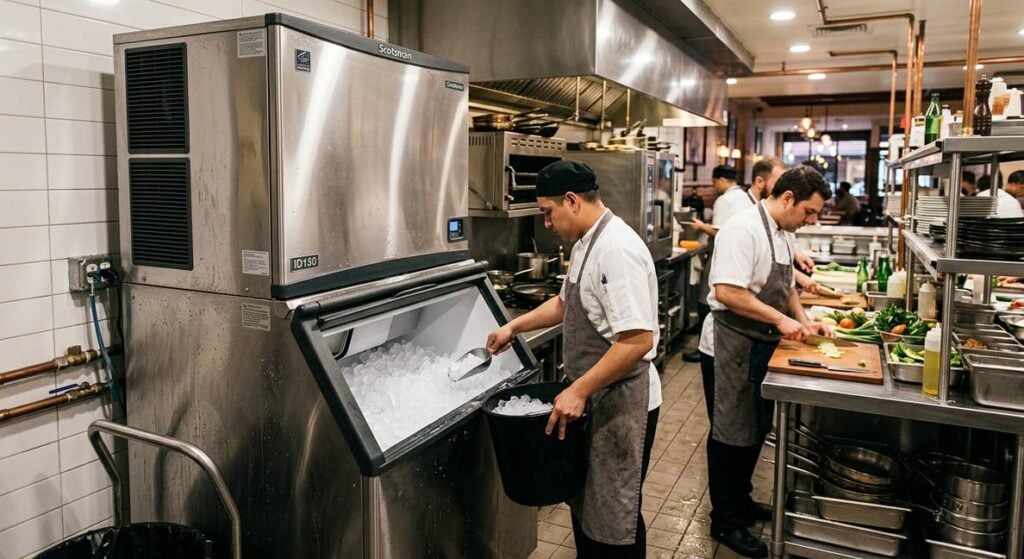
The stretch from Thanksgiving through New Year’s is the moment every Galveston kitchen either shines or scrambles. Cruise ships turn over, Dickens on The Strand fills the sidewalks, Moody Gardens lights up, and every seat on Seawall Boulevard gets sat, resat, and sat again. Your walk-in cooler and your ice machine work harder in six weeks than they do the rest of the year combined.
The good news: the vast majority of holiday refrigeration emergencies are preventable. The bad news: they almost always happen on a Friday night when your walk-in has forty pounds of prime rib in it and every technician on the island is already booked.
This guide walks Galveston restaurant, bar, hotel, and vacation rental operators through exactly how to prep commercial walk-ins, freezers, and ice machines for the holiday rush, why our coastal climate makes that prep non-negotiable, and how to spot the early warning signs before a small problem becomes a full breakdown.
Why the Galveston Holiday Rush Is Uniquely Hard on Commercial Refrigeration
Every busy kitchen on the Gulf Coast fights the same three-headed monster during November and December.
1. Humidity that never really leaves. Galveston County relative humidity stays above 75% most of the year and regularly climbs past 80%, even in “winter.” Every time a walk-in door opens on a humid day, warm, moist air rushes in, hits the cold coils, and freezes as frost. Multiply that by hundreds of door openings during a holiday shift and you get iced-over evaporators, longer defrost cycles, and warm zones on the top shelves.
2. Salt air that quietly eats metal. Salt-laden Gulf air lands on rooftop condensers, cabinet fasteners, hinges, door frames, and control panels. Uncoated aluminum coils can begin corroding within weeks. Standard rooftop units in Galveston and Texas City can lose 3 to 5 years off their expected life without protection. Refrigeration equipment shares the same fate, especially condensers on the roof or in outdoor mechanical yards.
3. Traffic that doubles overnight. The Strand district on a Dickens weekend, Pier 21 during cruise turnover, and Seawall Boulevard on New Year’s Eve produce the kind of covers that stress every seal, gasket, motor, and compressor in your building. More people means more door openings, more product turnover, more warm inventory pulled in from receiving, and more ice pouring out of the well every fifteen minutes.
Add in longer operating hours, overstocked walk-ins, and staff too slammed to notice a slightly noisier compressor, and you have the perfect conditions for a holiday breakdown.
Your Walk-In Cooler and Freezer Holiday Prep Checklist
Commercial refrigeration technicians see the same handful of failures again and again during the holiday rush. Every item below is one your team can knock out (or hand to your service provider) two to four weeks before Thanksgiving.
1. Deep-Clean the Condenser Coils
Dirty condenser coils are, by a wide margin, the number-one cause of walk-in cooler failure. Grease from a busy kitchen, dust, lint, and salt residue all mat onto the fins. The coil can no longer reject heat, head pressure climbs, the compressor runs constantly, and eventually it gives up.
Have a technician deep-clean the coils, rinse them, and clear at least the manufacturer’s minimum clearance around the unit. On a coastal building, plan on quarterly coil cleaning at a minimum, monthly if the condenser is on a roof or otherwise directly exposed to salt air.
2. Inspect and Replace Door Gaskets
Door gaskets are the second-most-common failure point technicians report in the Galveston and Houston market. Run a dollar bill test on every walk-in: close the door on it, pull, and if it slides out easily, the gasket is done. Look for cracked, flattened, or torn sections, and check the corners where hinges pull hardest.
Bad gaskets in Galveston are not just a small energy penalty. They let 80% humidity Gulf air stream in continuously, which puts frost on the coils, ice on the floor, and eventually kills the compressor from overwork.
3. Check Doors, Hinges, and Closers
Look at whether your walk-in doors actually close on their own. Adjust or replace the closers if they do not. On high-traffic boxes, consider strip curtains or air curtains to knock down infiltration during the holidays when doors get held open longer.
4. Test the Defrost System
Freezers fail more often than coolers during the holidays, and defrost problems are the reason why. Have a technician verify heaters, timers, and termination controls, and adjust intervals if you are seeing chronic ice buildup. Do not just chip the ice off. Find out why it is forming.
5. Get a Refrigerant Leak Check
Refrigerant does not burn off. If a unit needs a top-off, it has a leak. One industry dataset attributes about 20% of emergency walk-in failures to refrigerant leaks. Have your technician use a proper leak detector, repair what they find, replace the drier, evacuate, and weigh in the correct factory charge. Never let anyone “top off” a system without finding the source.
6. Verify Airflow and Loading
Walk through every box with your kitchen manager and look at how it is packed. Boxes stacked against the fan guards, product stuffed to the ceiling, or pallets blocking the evaporator all choke airflow. Reset the loading plan now, before receiving triples in size the week of Thanksgiving.
7. Clean the Condensate Drain Lines
Clogged drain lines cause water pooling, ceiling drips, and secondary ice buildup that jams doors and fans. Flush the drains, verify slope, and inspect any insulation for mold, especially on a coastal building where wet insulation is a chronic issue.
8. Calibrate Thermostats and Test Alarms
Thermostat and control problems account for a huge share of walk-in emergency calls in some service datasets. Verify setpoints, calibrate sensors, and if you have remote monitoring or high-temperature alarms, test them. There is no worse feeling than discovering at 6 AM that the walk-in was 55 degrees all night and no alarm ever went off.
9. Inspect Electrical and Fan Motors
Have contactors, capacitors, and relays inspected for heat damage or corrosion, and confirm every evaporator and condenser fan is running smoothly. On the coast, salt film on terminals is a recurring problem. Corroded contacts fail under holiday-level duty cycles.
Getting Your Ice Machine Ready for the Holiday Rush
The ice machine is the piece of equipment operators most often take for granted, right up until it dies at 8 PM on New Year’s Eve. Give it the same seriousness as the walk-in.
Forecast Your Actual Ice Demand
Before you touch a wrench, figure out how much ice you actually need on your peak day. Industry rules of thumb are surprisingly reliable.

A 150-seat Galveston seafood house doing two turns for a holiday dinner (roughly 300 covers) is looking at about 600 pounds of ice per day at 2 pounds per person. Add a 30% holiday buffer and you want your machine plus your bin capable of pushing 780 to 800 pounds through service. If your current machine is not sized for that, it is time to plan for either a bigger unit, scheduled bagged ice deliveries, or both.
Deep-Clean and Sanitize the Machine
A pre-holiday deep clean is non-negotiable, especially in a coastal climate where warm humidity accelerates biofilm and slime growth. Run a full descaling and sanitizing cycle with a commercial ice machine cleaner per the manufacturer’s instructions, and while the machine is open, inspect the evaporator plate, water distribution tubes, and internal reservoir for scale.
Document the date, the products used, and who did the work. Health inspectors love that paper trail. So does the next technician who touches the unit.
Change the Water Filter and Check Water Quality
Cloudy, small, or hollow cubes almost always trace back to water quality or scale. Change the water filter before the holidays and confirm inlet pressure is between 40 and 100 PSI. If you have not had your water tested in a while, this is a good time.
Verify Ventilation and Ambient Temperature
Most ice machines are rated to operate best between 50 and 90 degrees ambient. Walk around the machine and confirm nothing (boxes, kegs, holiday decor, catering supplies) is blocking the intake or exhaust. Air-cooled machines are especially sensitive. In a Galveston back-of-house that runs warm, even a couple of blocked inches of clearance can drop production noticeably.
Test the Electrical and Drain Path
Confirm the machine is on its dedicated circuit, there are no loose or corroded terminals, and the drain is clear and properly sloped. A tripped breaker in the middle of a Saturday night rush is the kind of avoidable problem that ruins a holiday weekend.
Stock Spare Parts and Cleaner
Keep a spare water filter, an approved ice machine cleaner and sanitizer, and any technician-recommended gaskets or hoses on hand. The parts are cheap. The 4 AM emergency service call is not.
Consider Ice Machine Warning Signs
Even a well-maintained machine will give you a heads-up before it fails. Train someone on every shift to check for:
- Dropping production. The bin is not filling like it used to at the same load.
- Poor cube quality. Cloudy, hollow, or fused cubes point to scale, low refrigerant, or interrupted freeze cycles.
- New noises. Rattling, grinding, or squealing from the compressor, fan, or water pump.
- Water on the floor. Leaks or drain issues that will only get worse under load.
- Continuous running. A machine that never cycles off yet still produces less ice than usual is overworking and heading for a failure.
- Warm cabinet. Panels and surrounding air that feel unusually warm mean the condenser is not rejecting heat.
Any of these signals should trigger a call, not a “we will get to it after the holidays” response.
The Galveston Factor: Salt, Humidity, and Coastal-Specific Steps
Galveston refrigeration is not the same job as refrigeration in Dallas or Austin. A few coastal moves make a huge difference.
Rinse Outdoor Condensers Every Month
Rinse rooftop and outdoor refrigeration condensers monthly with low-pressure water to knock salt off the fins before it bonds to the metal. Do not use high pressure (you will bend the fins), and keep water out of the electrical enclosure. This one habit alone can add years to a coastal condenser.
Specify Coastal-Rated Components
When you replace coils, cabinets, or hardware, spec epoxy-coated condenser coils, stainless steel or marine-grade fasteners, and NEMA-rated, gasketed electrical enclosures. The upcharge is trivial compared to a corroded compressor two winters from now.
Manage Indoor Humidity
If your main building HVAC is undersized or not dehumidifying properly, humid air in the prep area gets pulled straight into every walk-in door opening. A quick check on your HVAC dehumidification performance before the holidays is worth it. If your rooftop unit is struggling, address it now, not in July.
Check Anti-Sweat Heaters
Galveston humidity around cooler door frames produces heavy condensation. Confirm your anti-sweat heaters are working and correctly set so doors do not fog up, drip on the floor, and slick up the entrance to the walk-in during a rush.
The Two-Week Countdown Before Thanksgiving
If you want a single, do-this-and-you-are-covered timeline, here it is.
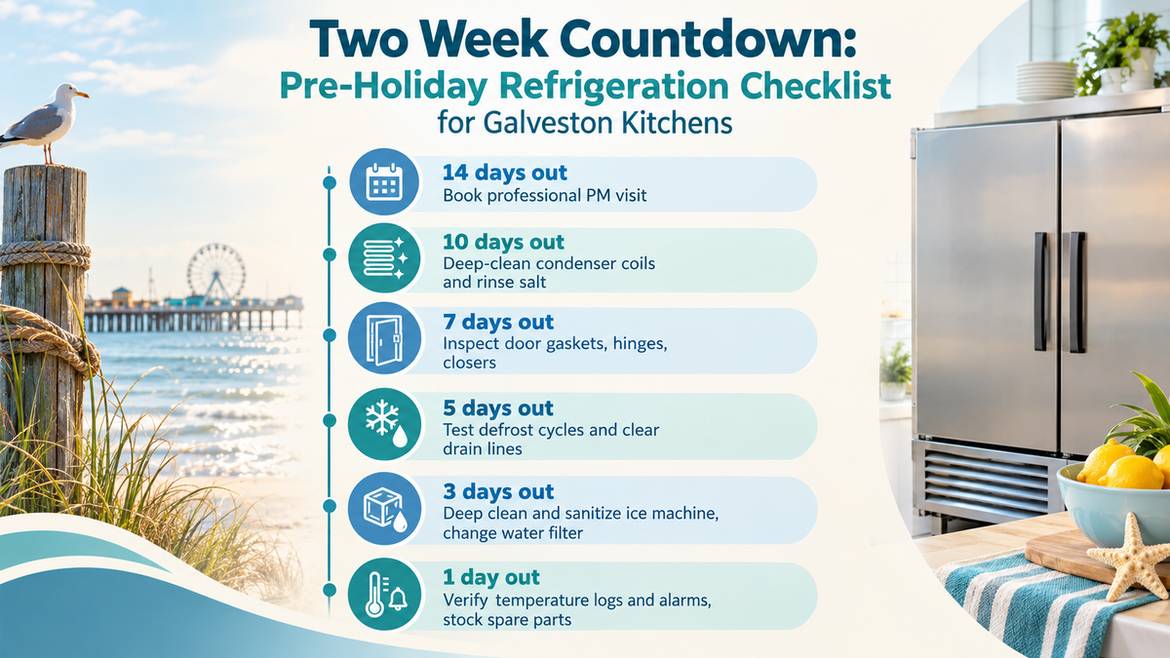
The whole point of this countdown is to get problems surfaced during business hours, on a slow weekday, when parts are available and your service company is not already booked solid for the weekend.
Where Coastal Comfort Fits In
Coastal Comfort has been keeping Galveston County businesses cool since 1954, first as Townley Refrigeration and now as Coastal Comfort, with a service area that stretches across the island and up the mainland through Kemah, Seabrook, Friendswood, and Freeport. We service commercial refrigeration alongside residential and commercial HVAC, which means the same team that keeps your dining room comfortable also knows the equipment behind the line.
If your walk-in is icing, your ice machine is dropping production, or you just want a professional PM visit on the books before Thanksgiving, here are the pages that will get you the fastest answer.
- Commercial Ice Machine Repairs in Galveston: service, cleaning, and repair for ice machines across the island.
- HVAC Repair Services: fast, honest repair for AC, heating, and rooftop equipment across Galveston County.
- Heating Repair: furnace, heat pump, and rooftop heating repair before the first cold front rolls off the Gulf.
- Vacation Rental Owners: a scheduled maintenance and 24/7 response program built for absentee owners and property managers.
- Service areas across the coast: Tiki Island, Hitchcock, Bacliff, Kemah, Seabrook, Dickinson, Friendswood, and Freeport.
For same-day and emergency response, call (409) 202-2188, seven days a week. Read customer reviews from Galveston businesses and homeowners, or learn more about the team on our story page.
Get Ahead of the Rush
Every walk-in emergency Coastal Comfort responds to during the holidays started as a small problem weeks earlier: a coil that needed cleaning, a gasket that needed replacing, a leak that needed finding. The kitchens that sail through the holiday season are not lucky. They are the ones who booked the preventive maintenance visit while the calendar was still quiet.
Book yours now. Get in touch here, and we will get you on the schedule before Thanksgiving.

Frequently Asked Questions
How often should a Galveston restaurant have its walk-in serviced?
A minimum of every six months is the baseline for any commercial walk-in. High-volume restaurants, bars, hotels, and grocery operators along the Galveston coast should plan on quarterly preventive maintenance, with the pre-holiday visit ideally landing in October or the first week of November. Salt air, humidity, and heavier holiday duty cycles make this even more important than the same interval would be inland.
What is the single most cost-effective refrigeration repair a Galveston operator can make?
Replacing worn door gaskets. Gaskets are inexpensive, the labor is quick, and a failed gasket in an 80% humidity environment causes cascading problems (frost, ice, long run times, compressor overwork) that end up costing far more than the gasket itself.
Why is my ice machine producing cloudy or hollow cubes?
Cloudy ice usually points to water quality and mineral buildup. Small or hollow cubes suggest the freeze cycle is being cut short, often by scale on the evaporator or a low refrigerant charge. Change the filter, run a full descale, and if the problem persists, call a technician to check refrigerant and controls before the machine fails outright.
How much ice does a busy Galveston restaurant actually need on a holiday night?
A general planning number is 2 pounds of ice per person served per day, or about 1.5 pounds for a full-service restaurant and 3 pounds for a cocktail bar. Add a 20 to 30% holiday buffer on top. A 300-cover holiday night, then, calls for planning around 780 to 800 pounds of ice-day capacity between the machine and any storage in the walk-in freezer.
Do I need coastal-rated equipment in Galveston?
Yes. Standard rooftop and outdoor refrigeration units can begin corroding within weeks of exposure to Galveston’s salt air, and their useful life drops by 3 to 5 years without protection. Epoxy-coated coils, stainless or marine-grade fasteners, and NEMA-rated electrical enclosures are worth the small upcharge.