
The first real cool front rolls into Galveston, you finally flip the thermostat over to heat, and within a minute the house has that unmistakable “hot dust” smell coming out of every vent. If your furnace smells like burning when first turned on, you are not alone, and in most cases you are not in any immediate danger.
But “most cases” is not “every case.” Some burning smells are just harmless dust cooking off components that have not been touched since March. Others are the earliest sign of a clogged filter, an overheating blower motor, a stressed heat exchanger, or an electrical problem that needs a technician on the property today.
This guide walks you through the difference. It is written specifically for homeowners along the Texas Gulf Coast, where our long cooling season, salty humid air, and infrequent heat use create some of the exact conditions that cause seasonal furnace odors in the first place. By the end you will know how to tell a normal smell from a dangerous one, what to do in the next ten minutes, and when it is time to pick up the phone.
Is a Burning Smell From Your Furnace Normal? The Short Answer
A light, dusty, slightly “hot” smell that shows up only the first time you run the heat for the season and fades within about 30 to 60 minutes of continuous operation is almost always dust burn-off. It is one of the most common and least worrying complaints HVAC techs get every fall.
A smell that is sharp, chemical, plastic, electrical, oily, musty, or (worst of all) smells like rotten eggs is a different story. So is any smell that lingers past an hour, gets stronger every cycle, or shows up with visible smoke, scorch marks, or a headache.
Here is a quick decision reference you can screenshot for later:
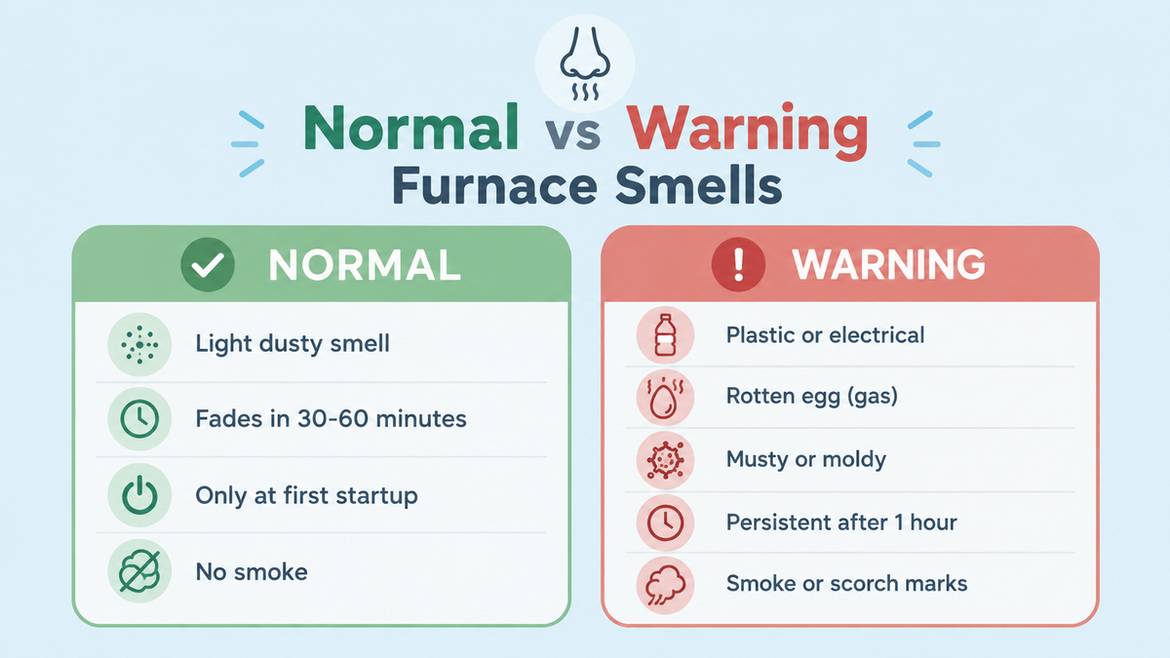
If your situation is on the left side of that graphic, you can probably relax, open a window, and let the system do its thing. If any warning sign on the right applies, keep reading, especially the safety-steps section further down.
Why Your Furnace Smells Like Burning When First Turned On
The mechanism behind the “first heat of the year” smell is refreshingly simple. Every summer, your air handler and duct system slowly collect a fine layer of household dust, pet dander, lint, pollen, and, in coastal homes, a bit of salt-tinged humidity residue. That layer settles on the parts of the furnace that get the hottest first: the heat exchanger, the burners on a gas system, the resistance coils on an electric one, and the surrounding sheet metal.
When you fire the system up in October or November, those surfaces climb past 150 to 200 degrees Fahrenheit in a matter of minutes. The dust does exactly what dust does when you toss it into a candle flame: it incinerates. The byproduct is a dry, faintly smoky odor that gets carried through the ducts and out of every supply register in the house.
That is why the smell is:
- Strongest at the first startup of the season, not in the middle of winter
- Worse in Galveston than in, say, Amarillo, because our furnaces sit idle much longer
- More noticeable in homes with pets, carpet, or nearby construction, because there is simply more dust to burn
The Napoleon and BTAC HVAC guides both estimate the normal burn-off should fade within roughly 30 to 60 minutes of continuous heating. Some technicians use a “30 minute rule”: if the smell is not clearly weaker after half an hour, something else is going on.
7 Real Reasons a Furnace Smells Like Burning at First Startup
Dust burn-off is the most common culprit, but it is not the only one. Here are the seven causes we see most often in Galveston County homes, roughly in order from “annoying but harmless” to “shut it down and call us.”
1. Dust burn-off after months of idle time
Symptoms: Light, dry, dusty smell from every vent, only at the very first startup, no smoke, no headaches.
What is happening: Exactly what we described above. Dust on the heat exchanger and burners is being cooked off.
What to do: Open two windows on opposite sides of the house to cross-ventilate, let the furnace run for 30 to 60 minutes, and see if the smell fades. This is a great moment to also swap in a fresh air filter, which brings us to number two.
2. A clogged or filthy air filter
Symptoms: Dusty or slightly scorched smell that keeps coming back every heating cycle, weaker airflow from vents, sometimes the furnace short-cycles (turns on and off quickly).
What is happening: A filter that has been in place since spring is now caked with dust and Gulf-coast humidity residue. It restricts airflow, which forces the blower motor and heat exchanger to run hotter than designed. Trapped debris on the filter itself can start to scorch, and the whole system smells “cooked.”
What to do: Pull the filter and look at it against a light. If you cannot see light through it, replace it. Standard 1-inch filters in Galveston homes typically need replacing every 60 to 90 days during heavy use, more often if you have pets, are near active construction, or run the system a lot after a storm.
3. An overheating blower motor or worn bearings
Symptoms: Hot, oily, or slightly rubbery smell. Sometimes a mechanical whine or grinding under the smell. Vents blow air that never quite feels warm enough.
What is happening: The blower motor’s bearings are worn, or the motor is being forced to work against restricted airflow. Friction and heat build until the surrounding oil, insulation, or belt (on older systems) starts to give off odor.
What to do: This is a repair, not a DIY fix. Shut the system down at the thermostat and call for heating repair. Running a struggling motor can burn it out completely, which turns a bearing job into a full motor replacement.
4. Electrical or wiring problem
Symptoms: Sharp, acrid, “burning plastic” or “hot electronics” smell. Sometimes an ozone-like tang, like a lightning storm. Occasional flicker on nearby lights or a tripping breaker.
What is happening: A wire is chafed, a connection is loose, a capacitor is failing, or a control board is overheating. Salt air in coastal homes accelerates corrosion on terminals, which is one reason we see this more often on the island than inland.
What to do: Shut the system off at the thermostat, then flip the furnace’s dedicated breaker off at the panel. Do not restart it to “test.” Call a technician. This is exactly the smell that precedes small electrical fires.
5. Something is stuck in the ductwork or on a register
Symptoms: Burning smell isolated to one or two rooms, sometimes with a hint of paper, fabric, or plastic.
What is happening: A stray toy, a plastic bag, a rodent nest, or (this actually happens) a forgotten dryer sheet stuck to a return grille is being baked by warm air. In beach houses closed up for weeks at a time, it is not unusual for something to end up where it should not.
What to do: Turn the system off, walk each room, and check every register and return grille. If you find nothing and the smell is coming from a specific vent, that is a duct inspection call.
6. A cracked or failing heat exchanger
Symptoms: Metallic, formaldehyde-like, or chemical smell. Sometimes headaches, dizziness, or a burning-eye feeling in the household. Yellow rather than blue flame on a gas furnace.
What is happening: The heat exchanger is the metal wall separating combustion gases from the air you breathe. When it cracks, combustion byproducts (including carbon monoxide) can leak into the house.
What to do: Shut the system down immediately, open windows, get everyone outside, and call for service. Do not run the furnace again until a technician has inspected and, if needed, replaced the heat exchanger. If you have any suspicion of carbon monoxide exposure (headache, nausea, confusion) call 911.
7. Mold, mildew, or “wet” burning smells (a very coastal problem)
Symptoms: Musty, damp, or slightly sour smell that turns into a “burning wet dust” odor once the heat kicks on. Often stronger in humid weeks after a tropical system.
What is happening: Galveston’s humidity finds its way into every corner of an HVAC system. When a furnace sits unused for months in a damp attic or closet, moisture wicks into insulation, ductboard, and dust. When you finally heat that up, the smell is somewhere between “burnt” and “musty basement.”
What to do: Change the filter, run the system with the thermostat fan set to “on” for an hour with windows open, and see if the smell clears. If it does not, or if anyone in the home has respiratory symptoms, request a duct and coil inspection.
What To Do in the Next 10 Minutes: A Safety Flow
Do not scroll past this section. The right first move depends entirely on what kind of smell you are dealing with.
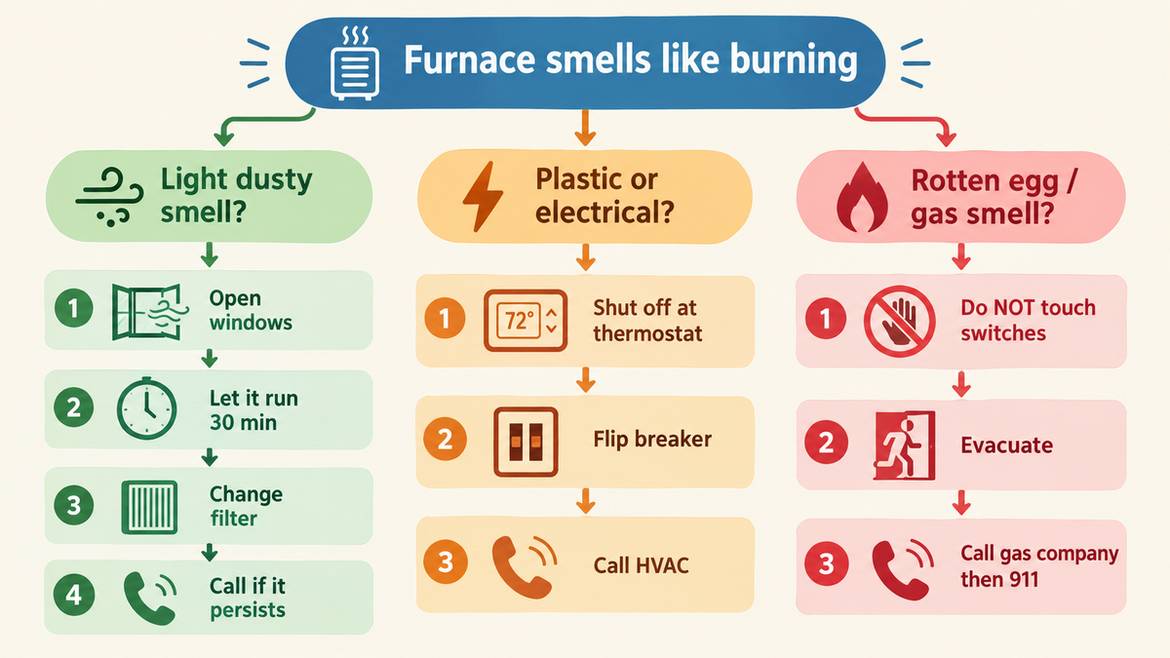
If it smells like rotten eggs (gas), stop reading and act
Natural gas in Galveston is scented with mercaptan so you can smell it. If the “burning” smell has any hint of sulfur or rotten egg to it:
- Do not touch the thermostat, light switches, breakers, or any electronics. A spark can ignite gas.
- Do not use phones inside the house.
- Get everyone (including pets) outside and upwind of the home.
- From a neighbor’s house or outside, call CenterPoint Energy at 713-659-2111 (24/7 gas leak line) or 911, then call your HVAC company.
If it smells electrical or like burning plastic
- Switch the thermostat to “Off.”
- Go to the electrical panel and flip the furnace’s breaker off.
- If you see visible smoke, sparks, or a scorch mark, leave the house and call 911.
- Otherwise, call a licensed HVAC technician the same day. Do not restart the system to “check if it is fixed.”
If it smells like light burning dust (the common case)
- Open two windows on opposite ends of the house for cross-ventilation.
- Set the thermostat fan to “On” so air keeps moving even when the burners cycle off.
- Let the system run for 30 to 60 minutes.
- Swap in a clean air filter.
- If the smell has clearly weakened by the one hour mark, you are almost certainly in dust burn-off territory. If it has not, treat it like an unknown-cause smell and schedule a diagnostic.
If you have any doubt at all
Test your carbon monoxide detector. If you do not have one, get one today, either battery or plug-in models are inexpensive at any Galveston hardware store. Then call for a professional heat check. A $95 diagnostic is a very small price for peace of mind, and if it is real, catching it early is the difference between a repair and a replacement.
Why Galveston and Gulf Coast Homes Get These Smells More Often
Every part of the country deals with fall furnace smells, but the way homes are built and used along the Texas coast makes it a bigger issue here.
- We use the heat rarely. Galveston’s average January low sits in the mid-40s, and many years we run heat on fewer than 40 days. That is nine or ten months of dust accumulation before a fall startup, versus four or five in the northern United States.
- Salt air is corrosive. Even homes on the mainland side of the causeway get salt-laden humidity blown inland. Salt attacks copper, aluminum, and electrical contacts, which is why coastal HVAC systems are more prone to the electrical and heat exchanger failures on this list.
- Storm season leaves systems damp. If your air handler is in an attic or garage that flooded, sweated, or lost power for days after a tropical system, moisture makes it into insulation and ductwork. That is prime territory for the mold/mildew smell described in reason seven.
- Vacation rentals sit idle for weeks. A beach home in Jamaica Beach or the West End might not have anyone through the door from June to October. Dust settles, moisture creeps in, and the first heat cycle after a long vacancy tends to smell dramatic.
If you manage a beach home, our team works specifically with vacation rental owners across the island to schedule pre-season startups so guests never smell what you smelled.
When To Call a Galveston HVAC Technician
You should book a professional visit if any of these are true:
- The smell is sharp, plastic, electrical, chemical, oily, or musty rather than “dry dust”
- The smell lasts longer than about one hour of continuous heating
- The smell returns every time the furnace runs, not just at first startup
- You see smoke, visible scorching, or discoloration near the unit or vents
- Your carbon monoxide detector alarms, or anyone feels headache, dizziness, or nausea
- The furnace short-cycles (turns on for a minute, off for a minute) repeatedly
- The system trips a breaker
- The furnace is 10 or more years old and has not had a professional tune-up in the last 12 months
Coastal Comfort offers same-day and 24/7 emergency service across Galveston County, with a flat $95 diagnostic fee and a written quote before any work begins. If you have already narrowed it down to one of the more serious causes above, our heating repair team can typically get parts on hand for most furnaces on the island the same day.
We serve Galveston Island, Tiki Island, Bacliff, Kemah, Seabrook, Dickinson, Hitchcock, Freeport, and Friendswood.
Preventing Burning Furnace Smells: A Coastal Maintenance Checklist
You will never eliminate the “first cool front” dust smell completely, but you can make it milder and less frequent with a short, coastal-friendly routine.
- Change filters every 60 to 90 days. Sooner if you have pets, ongoing construction, or high pollen weeks. Use MERV 8 to 11 for the best balance of dust capture and airflow in most Galveston homes.
- Run the system in fan-only mode a couple of times in September. A 30 minute “circulation” run before you actually need heat lets you catch a burning smell in tolerable weather with the windows open.
- Schedule a fall heat check. A pre-season tune-up cleans burners, inspects the heat exchanger, tests electrical connections, and checks combustion. It is the single most reliable way to avoid a middle-of-a-cold-front breakdown. Book one through our contact page.
- Keep the outdoor unit and any exterior vents clear of salt-crusted debris. After a storm, a quick rinse of the condenser with fresh water (system off) helps.
- Test smoke and carbon monoxide detectors every October. Twice a year is the National Fire Protection Association recommendation. October is a good anchor date because it is right before heat use ramps up.
- For vacation rentals, do a “wake-up” service before every long booking after summer. Filter, fan run, and a quick diagnostic can save you a guest complaint at midnight.
The Bottom Line
If your furnace smells like burning when first turned on for the season, take a breath, look at what kind of smell it is, and match it to the list above. Most of the time, especially the very first cool morning of the year, it is harmless dust burning off and it clears in under an hour.
But every year we take calls from Galveston homeowners who lived with a “little smell” for weeks and turned a $200 repair into a $2,000 one, or worse, missed the early warning of a heat exchanger crack. When in doubt, err on the side of an inspection. It is faster, cheaper, and safer than guessing.
Ready to get it checked, or want to book a fall tune-up before the next cool front? Call Coastal Comfort, request a same-day visit through our contact page, or read what your neighbors are saying on our reviews page. We are open seven days a week, 9 AM to 6 PM, with 24/7 emergency service across Galveston County.

Frequently Asked Questions
How long should a new furnace smell like burning?
A brand new furnace can give off a stronger, sometimes plastic-tinged smell for the first two or three heating cycles as manufacturing oils, protective coatings, and paint cure on the heat exchanger. Most installers estimate that odor should clearly fade within eight to twelve hours of total run time, spread over the first few days. If it is still strong after that, or if it smells like sharp plastic rather than a mild curing odor, contact your installer.
Is it safe to run a heater that smells like burning?
If the smell is light, dry, dusty, and clearly fading in the first 30 to 60 minutes, it is generally safe to keep running. If the smell is sharp, chemical, plastic, electrical, sulfurous, or growing stronger, it is not safe. Shut the system down at the thermostat and, if it is not a gas smell, at the breaker, and get it inspected.
What are the signs of a dying furnace?
Common signs include: burning or musty smells that come back every cycle, weaker or uneven airflow between rooms, short-cycling, a yellow rather than blue burner flame on a gas system, rising energy bills for the same thermostat settings, unusual noises (rumbling, banging, high-pitched whines), rust or soot around the unit, and any breaker trips tied to the furnace. Any two of these together on a system older than 12 to 15 years usually means a replacement conversation is worth having.
Is there a smell before an electrical fire?
Yes. Overheating wiring, capacitors, and control boards typically give off a sharp, “hot plastic” or acrid ozone-like odor before there is any visible smoke or flame. If a furnace suddenly starts smelling like burning plastic or hot electronics, treat it as an electrical warning: shut off the thermostat, flip the breaker, and call for service before restarting.
Why does my furnace smell like burning hair or dust in a coastal home like Galveston?
Two things stack up in coastal climates. First, the long cooling season means dust and pet dander have many months to settle on components. Second, humid Gulf air causes that dust to clump and adhere more tightly to coils and ductwork. When the system finally heats up, more dust cooks off at once, and the smell is more noticeable than in a drier inland climate. It is usually still dust burn-off, but paired with a filter change and an annual tune-up you can keep it mild.
Should I call an HVAC company or the gas company first?
If the smell has any sulfur or rotten egg character to it, call the gas company (or 911) first, from outside the home. For every other kind of burning smell, an HVAC company is the right first call. Coastal Comfort dispatches same-day when we can, and can talk you through the safest way to keep the system off in the meantime.