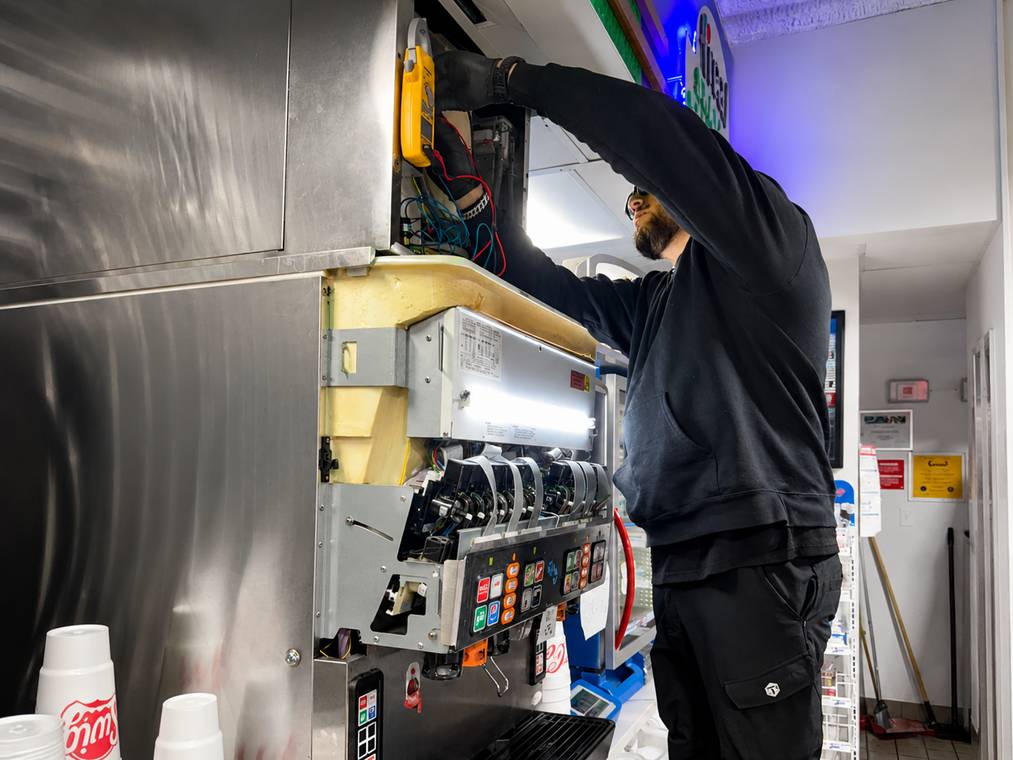
If you own or manage a restaurant, bar, or hotel along the Galveston coast, your ice machine is probably one of the hardest-working pieces of equipment in your building. It runs 24 hours a day, sits in a warm kitchen, and handles every drop of municipal water that arrives at the curb. That water is the single biggest factor in whether your ice machine lasts four years or ten, and whether you call a technician every three months or once a year.
The good news is that the fix is well understood and remarkably affordable. Proper water filtration cuts scale, sediment, and chlorine before they ever touch the inside of the machine. Industry data shows that more than 60% of commercial ice machine service calls are water related, which means a properly sized filter changes the entire economics of owning the equipment.
In this guide, our team at Coastal Comfort breaks down what is really in Galveston tap water, exactly how filtration extends the life of your ice maker, what it costs, and the kind of maintenance schedule you should expect once filtration is dialed in.
Why Galveston Water Is Tough on Ice Machines
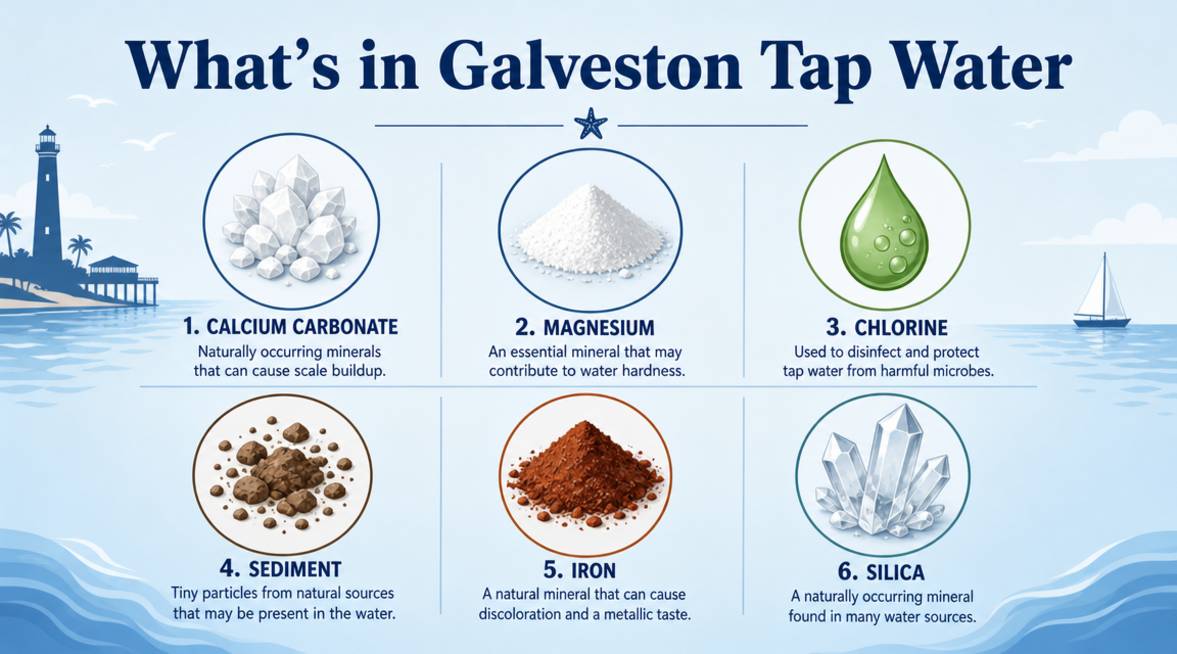
Galveston pulls its drinking water from the broader Texas Gulf Coast hydrologic system, which is fed by surface water and the Gulf Coast aquifer. That source naturally carries a heavy mix of dissolved minerals, sediment, and disinfection chemicals. None of it is unsafe to drink, but inside an ice machine those same constituents behave very differently than they do in a pint glass.
Three things are happening every minute your machine runs unfiltered:
- Scale formation. Calcium and magnesium bicarbonates fall out of solution as the water freezes and cycles, plating the evaporator, water distribution tubes, and float valves with a hard mineral crust.
- Sediment accumulation. Fine silt, silica, and pipe debris collect on screens, in pumps, and inside the reservoir, eventually clogging spray nozzles.
- Chemical attack. Chlorine and chloramine used to disinfect municipal water slowly oxidize rubber seals, gaskets, and plastic components. Coastal salt air on the outside of the cabinet accelerates the corrosion on the inside.
The result is a machine that produces cloudy, slow-melting ice, draws more electricity to do the same work, and eventually freezes up entirely. By the time a manager calls for service, the inside of the cabinet usually looks like the inside of a kettle that has never been descaled.
The Real Cost of Skipping Filtration
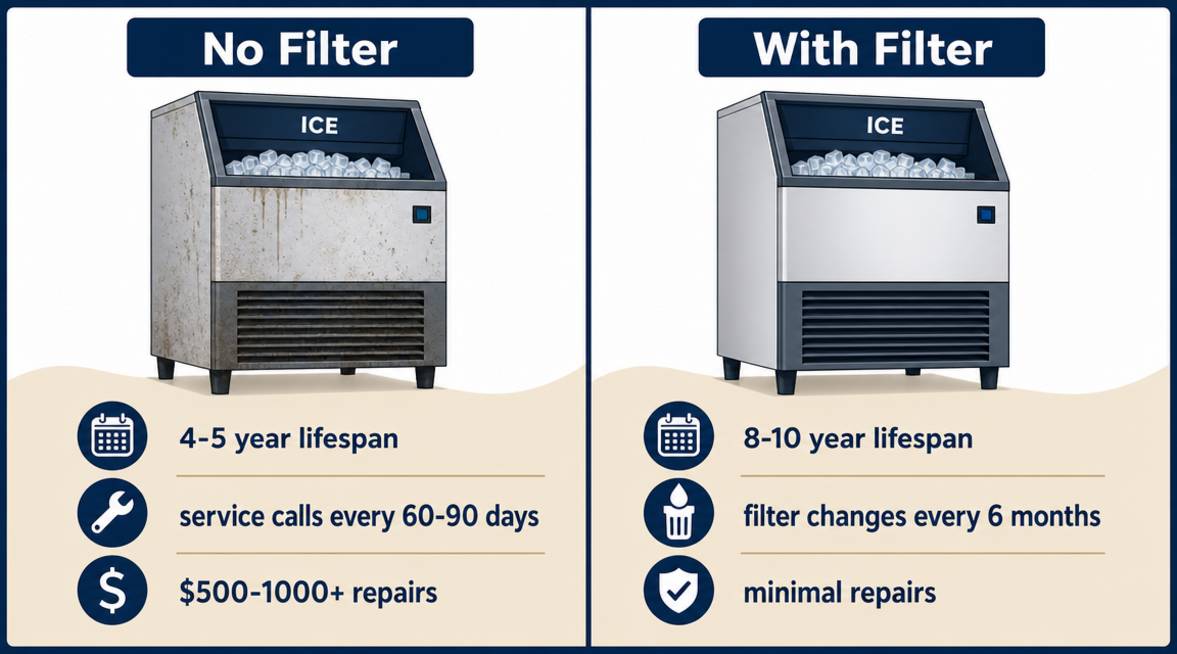
A standard ice machine repair call in the Galveston area runs a few hundred dollars per visit for cleaning, descaling, and minor part replacements. Major repairs, things like compressor swaps, evaporator replacement, or water pump rebuilds, climb past $1,000 quickly, and in some cases the most economical option is a full replacement.
Without filtration, here is the timeline most operators see:
- Months 1 to 6: Ice quality starts to slip. Cubes look hazy, melt fast, and pick up a faint mineral taste.
- Months 6 to 12: Production rate drops. The machine runs longer cycles to make the same amount of ice, energy bills creep up, and the bin sometimes runs empty during a Saturday rush.
- Year 2 to 3: First major service call. Usually a descaling, evaporator cleaning, and replacement of the water inlet valve.
- Year 4 to 5: Failure. Many unfiltered commercial machines on Galveston Island do not make it past their fifth birthday.
Compare that to a properly filtered machine. The HVAC industry consistently reports that ice makers maintained with regular filter changes can stretch their useful life toward 8 to 10 years, with service calls measured in single digits over the entire lifespan rather than several per year.
For a busy restaurant, the math is straightforward. A few hundred dollars per year in filters and changes, against thousands of dollars in repairs, lost ice production, and an early replacement bill. We see operators recoup the cost of a proper filtration installation in less than a year, sometimes inside a single summer season.
How Ice Machine Filtration Actually Works
A commercial ice machine filter is not a single cartridge that does one thing. The systems we install for Galveston foodservice clients are usually a treatment train with two or three stages, each one targeting a specific problem in the local water.
Stage 1: Sediment prefilter. A 5 micron or 1 micron pleated filter catches sand, silt, rust flakes, and pipe debris. This is the first line of defense and the cheapest stage to replace.
Stage 2: Carbon block with scale inhibitor. Activated or catalytic carbon strips chlorine, chloramine, and organic taste and odor compounds. A polyphosphate scale inhibitor, embedded in the same cartridge or added separately, sequesters calcium and magnesium so they stay suspended in the water and do not bond to surfaces inside the machine.
Stage 3: Softener or reverse osmosis, when needed. For high-volume operations on harder water, a small commercial softener or a point-of-use reverse osmosis unit handles the heaviest mineral load. RO is the gold standard for clarity, taste, and machine protection, and it is increasingly common in Galveston hotels and high-end restaurants.
The right combination depends on three factors: how hard the local water actually tests, how many pounds of ice the machine produces per day, and the manufacturer specifications. Hoshizaki, Manitowoc, Scotsman, and the other major brands all publish filter recommendations, and using the correct one is part of keeping the warranty intact.
A Realistic Maintenance Schedule With Filtration
Filtration does not eliminate maintenance, it just changes the schedule from reactive to predictable. Here is the rhythm we recommend for filtered commercial ice machines on Galveston Island.
Daily by staff:
- Wipe down the exterior and dispenser area
- Empty and inspect the bin for any cloudy or off-color ice
- Make sure the air-cooled condenser intake is not blocked
Weekly by staff:
- Sanitize the bin and scoop area
- Check the filter pressure gauge if your system has one
- Look for any water on the floor, the first sign of a slow leak
Every six months, by a technician:
- Replace the filter cartridges on schedule, not when they fail
- Deep clean and descale the evaporator and water distribution system
- Sanitize the water reservoir and inspect seals and gaskets
- Test water hardness and chlorine to confirm the filter is still performing
Annually:
- Full system inspection including refrigerant levels, condenser coil cleaning, and electrical check
- Review production rate against original specifications to catch slow degradation early
The key number to remember is six months for filter changes. Skipping that interval is the single most common reason a filtered machine still ends up with scale problems. Filters do not last forever, and a clogged or exhausted filter is in some ways worse than no filter at all because the operator assumes the protection is still in place.
How Filtration Fits Into a Larger Equipment Strategy
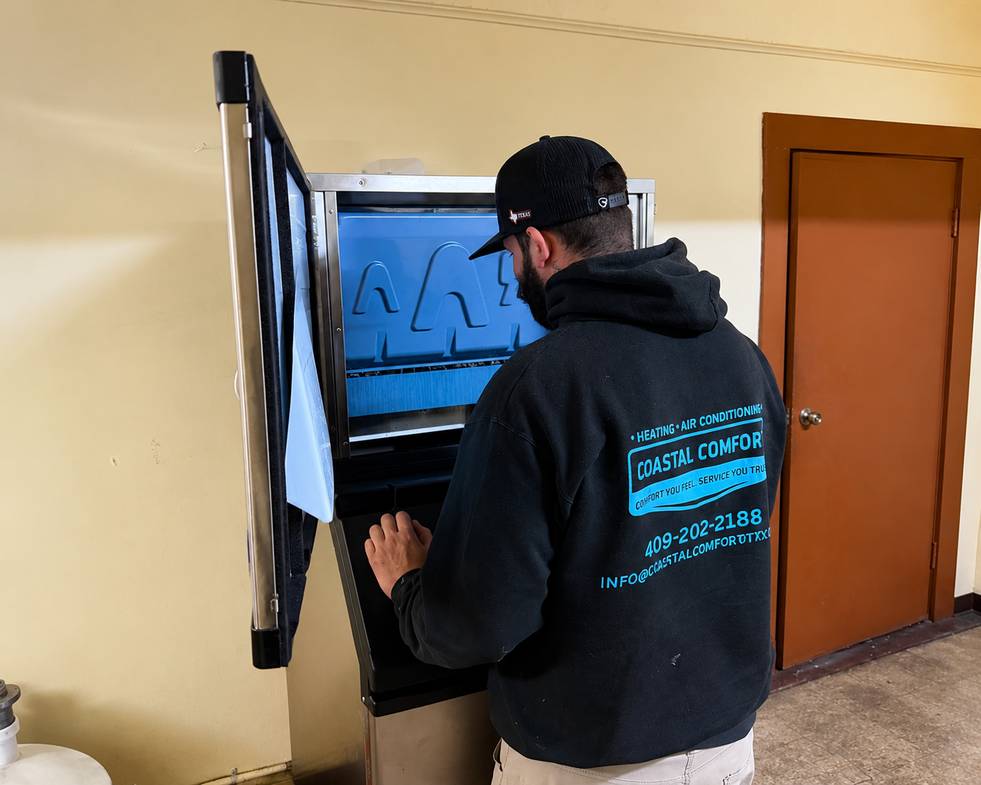
Ice machines do not live alone in a commercial kitchen. They sit alongside walk-in coolers, reach-ins, prep stations, and HVAC systems, all of which respond to the same coastal challenges. Salt air, humidity, and hard water affect every piece of refrigeration equipment in the building.
The same logic that justifies an ice machine filter applies to the broader equipment strategy. Preventive maintenance on the walk-in coolers and freezers, routine inspection of the commercial HVAC system, and a planned maintenance schedule keep small problems from becoming weekend emergencies.
For operators who want to consolidate everything under one schedule, our Comfort Club plans cover the whole package, from ice to air to refrigeration, on a single calendar that nobody at the restaurant has to remember.
The Bottom Line
Galveston tap water is hard on commercial ice machines. Dissolved minerals, sediment, chlorine, and coastal humidity wear down unfiltered equipment fast, driving up service calls and shortening its lifespan. Filtration is the simplest way to flip that equation and protect the quality of every drink you serve.
If your machine is already showing symptoms, or you just want to get ahead of the next breakdown, Coastal Comfort is here to help. We offer the best commercial ice machine repair services in the Galveston area.

Frequently Asked Questions
How often should a commercial ice machine filter be changed?
For most commercial machines, every six months. High-volume operations on hard water may need to change filters every three to four months. The cartridge should be replaced on a calendar schedule, not when it visibly fails, because an exhausted filter stops protecting the machine before it stops passing water.
Can a water filter really double the life of an ice machine?
Effectively, yes. Industry data consistently shows that filtered, well-maintained commercial ice makers reach 8 to 10 years of service, while unfiltered machines often fail by year four or five. The filter itself does not double the life, but it removes the conditions that cause early failure.
Will a filter affect ice production rate?
A properly sized filter does not slow the machine down. A filter that is too small or one that has not been changed on schedule absolutely can, because the machine is fighting restricted water flow. Sizing the filter to the manufacturer specification is essential.
Is reverse osmosis worth it for an ice machine in Galveston?
For high-volume restaurants, bars with serious cocktail programs, and hotels, often yes. RO produces the clearest ice and the most aggressive protection against scale. For smaller operations a carbon and scale inhibitor combination is usually sufficient and far less expensive.
What is the warranty implication of running an ice machine without a filter?
Most major manufacturers, including Hoshizaki, Manitowoc, and Scotsman, require or strongly recommend filtration as a condition of warranty coverage. Scale damage and water-related failures are commonly excluded from warranty repair when filtration was not in place.
How quickly can filtration be added to an existing ice machine?
In most Galveston installations we handle, the filter system can be added in a single visit of two to four hours, including a deep clean and descale of the existing machine. The downtime is short and the long-term return is significant.