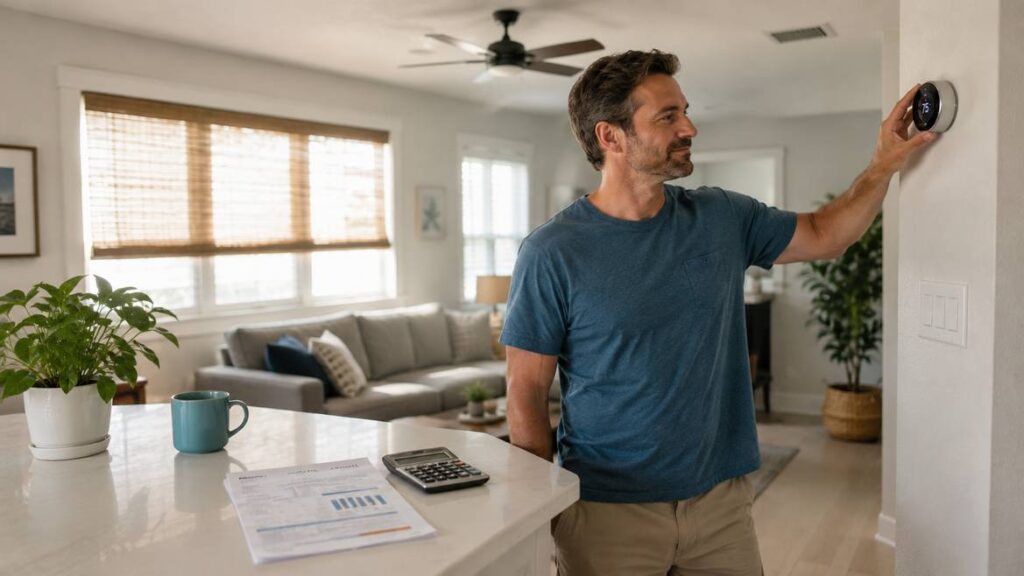
Summer on the Gulf Coast is no joke. The humidity rolls in early, the sun cooks the roof by mid-morning, and your air conditioner runs almost nonstop from April through October. By the time the electric bill arrives, a lot of Galveston homeowners ask the same question: is there a way to spend less without sweating it out?
The good news is yes. At Coastal Comfort, we work on AC systems across Galveston Island, Tiki Island, and Santa Fe every day, and we see the same small habits drain power on bill after bill. The fix is rarely “turn the AC off.” It is usually a handful of smart changes that let your system work less while keeping your home comfortable.
Here is what actually works in our coastal climate.
Set Your Thermostat the Right Way
Your thermostat is the single biggest lever on your cooling bill. Most people set it once and forget it, then wonder why the bill keeps climbing.
Here is the rule of thumb we share with our customers:
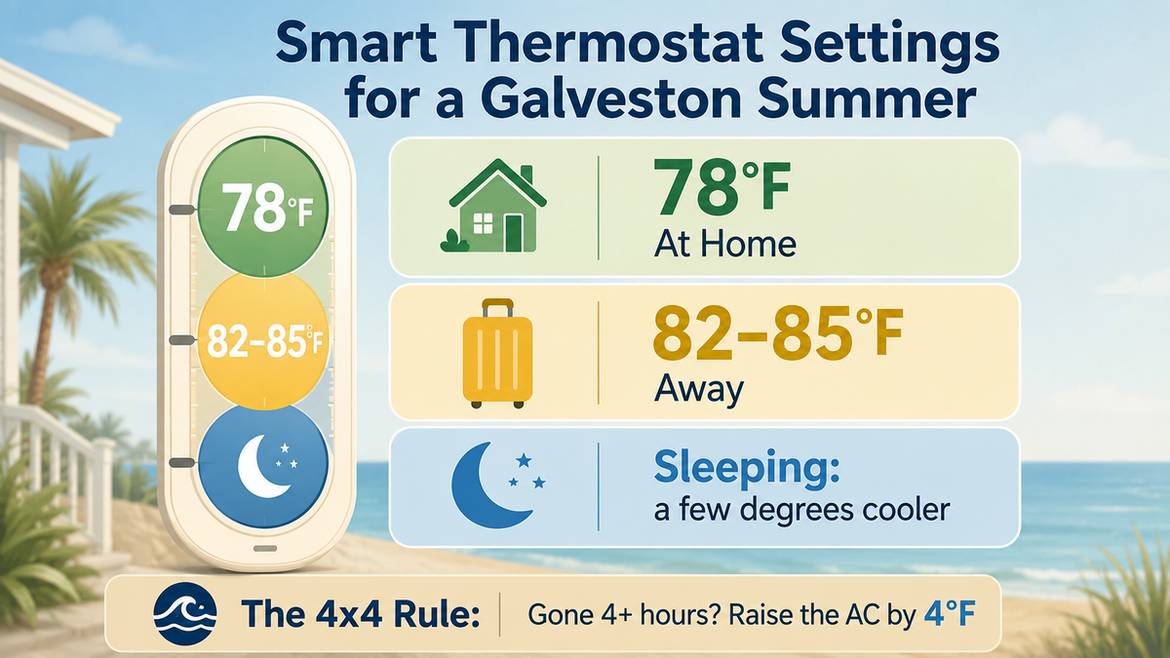
- 78°F when you are home and awake. This is the sweet spot most Gulf Coast HVAC pros recommend.
- 82 to 85°F when the house is empty. The smaller the gap between indoor and outdoor temperatures, the less your system has to work.
- A few degrees cooler at night if that helps you sleep, but only as much as you need.
There is also a simple trick called the “4 by 4 rule.” If you will be gone for 4 or more hours, raise the thermostat by 4 degrees. You can save on cooling without turning anything off.
Quick insight: The U.S. Department of Energy notes that you can save up to 10 percent a year on cooling by setting the thermostat back 7 to 10 degrees for about 8 hours a day. That is real money over a Galveston summer.
One mistake we see a lot: cranking the thermostat way down when you walk in to “cool the house faster.” It does not work that way. Your AC cools at the same rate no matter what number you set. All you are doing is making it run longer and use more power.
Use a Smart or Programmable Thermostat
If you are still turning the dial by hand, you are leaving savings on the table. A programmable thermostat lets you set a schedule once, and it follows it for you. A smart thermostat goes a step further. It learns your habits, adjusts when you leave the house, and can even be controlled from your phone.
We install and service smart thermostats often, and the difference on the next bill is usually obvious. If you want to know what makes sense for your home, our team at Coastal Comfort is happy to walk you through the options.
Beat the Humidity, Not Just the Heat
Here is something most people miss: in Galveston, humidity is half the battle. When the air inside your home is sticky, 76°F feels like 82°F. When it is dry, 78°F feels great.
A few ways to drop indoor humidity without lowering the thermostat:
- Use your AC’s “auto” fan setting instead of “on.” Running the fan all the time blows moisture from the coils back into the house.
- Run bathroom exhaust fans during and after showers.
- Use the range hood when you cook, especially with boiling pots.
- Aim for 45 to 55 percent indoor humidity. A small hygrometer from the hardware store will tell you where you stand.
If your home still feels damp at a comfortable temperature, your AC may be undersized, oversized, or in need of a tune-up. That is something we can check during a regular service visit.
Let Your Ceiling Fans Do More Work
Ceiling fans cool people, not rooms. That sounds obvious, but it is the key to using them right.
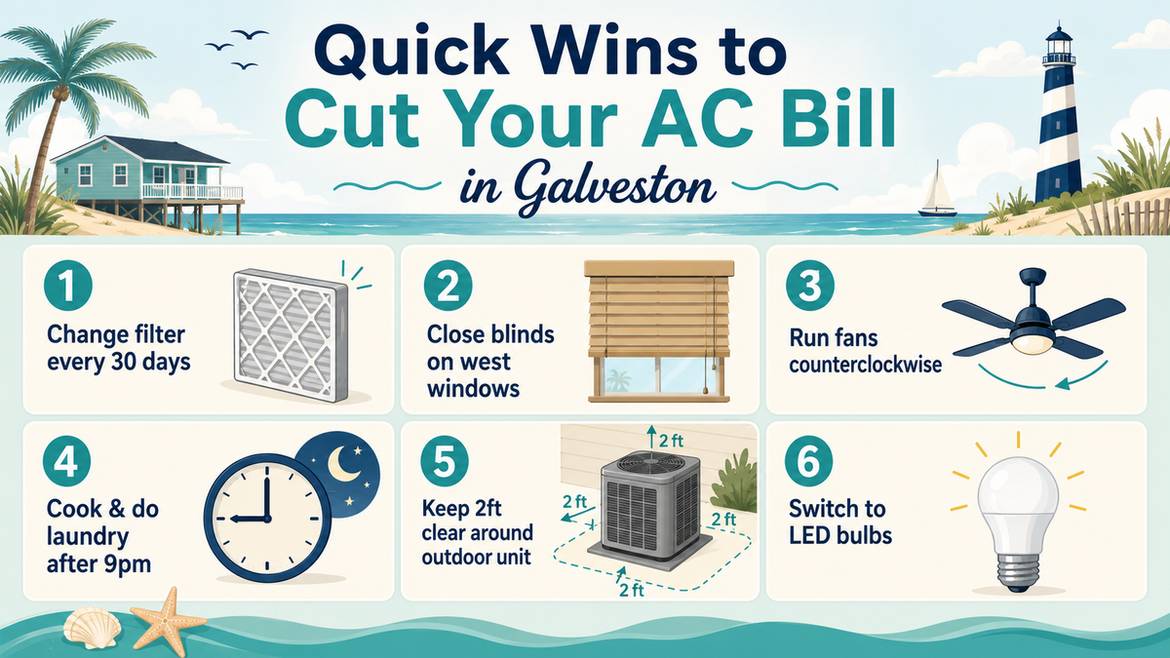
Set your fans to spin counterclockwise in summer so the blades push air down. The breeze on your skin can make a room feel up to 4 degrees cooler, which means you can bump the thermostat up a couple of notches and feel the same.
Two important habits:
- Turn fans off when you leave the room. A fan running in an empty room is just adding heat from the motor.
- Check your fan direction. Stand under the fan and look up. If you feel a breeze, it is correct for summer.
Block the Sun Before It Heats Your Home
Galveston gets serious sun, and a lot of it pours through south and west-facing windows. Once that heat is inside, your AC has to fight it.
The easiest fixes:
- Close blinds and curtains during the hottest part of the day. Especially on west-facing windows from late afternoon onward.
- Add blackout curtains, cellular shades, or solar screens to the windows that get the most sun.
- Consider window film on rooms that feel hot no matter what the thermostat says.
- Plant a shade tree or add an awning over sun-blasted windows. This is a longer-term fix that pays off year after year.
Even closing the blinds before you leave for work in the morning can shave a few degrees off the indoor temperature by the time you get home.
Change Your AC Filter Every Month in Summer
This is the cheapest, fastest energy-saving move we know. A clogged filter chokes airflow, forces the blower to work harder, and makes the whole system less efficient.
In a Galveston summer, when your AC runs almost daily, we recommend changing the filter every 30 days. If you have pets or family members with allergies, check it even sooner.
When you change the filter:
- Note the size on the old one before you head to the store.
- Slide the new one in with the airflow arrow pointing toward the unit.
- Set a recurring reminder on your phone so you do not forget.
A clean filter alone can cut energy use by 5 to 15 percent on a system that was running with a dirty one.
Take Care of the Outdoor Unit
That big metal box outside is the heart of your cooling system. In our coastal climate, it has to deal with salt air, sun, and tropical storms on top of everyday wear.
Keep it running efficiently by:
- Leaving 2 feet of clear space around the unit. Trim back shrubs, grass, and weeds.
- Rinsing the fins gently with a garden hose once or twice a year to wash off salt, dust, and pollen. Avoid pressure washers.
- Providing light shade if possible. A shaded outdoor unit can run up to 10 percent more efficiently than one in direct sun, as long as airflow is not blocked.
- Watching for leaning or rust. Salt air is hard on Gulf Coast equipment. Catching corrosion early protects your investment.
If you live near the beach in Galveston Island or Tiki Island, you already know how quickly salt damage adds up. Our HVAC maintenance team sees it every week.
Schedule a Summer Tune-Up Every Year
We tell every customer the same thing: a once-a-year AC tune-up is the best investment you can make in your cooling bill.
During a tune-up, our technicians:
- Clean the indoor and outdoor coils.
- Check refrigerant levels and pressures.
- Inspect electrical connections and tighten anything loose.
- Test the capacitor, contactor, and blower motor.
- Clear the condensate drain line, which clogs fast in humid climates.
- Verify the thermostat is reading and calling correctly.
A neglected AC can use 10 to 30 percent more energy than a well-maintained one. Multiply that across a long Galveston cooling season and the savings cover the visit several times over. For a full breakdown of what we look at, see our HVAC Maintenance Checklist for Galveston Homes.
Cut Indoor Heat From Appliances and Lighting
Every appliance that gets warm is fighting your AC. Small shifts in when and how you use them add up.
- Run the dryer and dishwasher after 9 p.m., when outside temperatures drop and electricity demand cools off.
- Cook outside or use a microwave, slow cooker, or air fryer on the hottest days. Heating up the oven for an hour will warm the whole house.
- Swap any remaining incandescent or halogen bulbs for LEDs. They use about 75 percent less energy and put out almost no heat.
- Unplug chargers and electronics you are not using. Phantom loads are small individually but add up across a whole house.
Did you know? A single old-style 60-watt bulb gives off about 85 percent of its energy as heat. Now multiply that by every fixture in your home and you can see why LEDs matter.
Seal Up Air Leaks and Boost Insulation
A leaky house is a constant drain on your AC. Cool air sneaks out, hot humid air sneaks in, and your system never gets to rest.
Two upgrades make the biggest difference in Gulf Coast homes:
- Attic insulation of R-38 or higher. Attics in our area can hit 130°F or more in summer. Good insulation keeps that heat from radiating down into your living space.
- Caulk and weatherstripping around doors, windows, attic hatches, and any spot where you feel a draft. Add foam gaskets behind exterior outlets if needed.
These are not glamorous projects, but they pay back every single month for the life of your home.
Pair Smart Habits With the Right HVAC System
All of these tips will help, but they work best on a system that is the right size, in good condition, and matched to a coastal climate. If your unit is more than 10 to 12 years old, runs constantly, struggles to keep up, or has rising repair costs, it may be costing you more to keep than to replace.
A newer, properly sized, high-SEER unit can cut cooling costs by 20 to 40 percent compared with an older system. There are also Texas energy rebates and federal incentives that can lower the upfront cost. Our 2026 Texas Energy Rebates and HVAC Incentives guide breaks down what is currently available.
If you are not sure whether your system is pulling its weight, call us. We are happy to come out, look it over, and give you an honest read.
Stay Cool, Spend Less
Lowering your energy bill in Galveston does not mean suffering through a hot house. It means being smart about how your AC runs, what it has to fight against, and how well it has been maintained.
At Coastal Comfort, we have spent years helping homeowners across the Galveston area get more out of their cooling systems. If you want a hand getting your home dialed in, whether that is a tune-up, a smart thermostat upgrade, or a full system replacement, reach out to our team. We are local, we know the climate, and we will give you straight answers about what will actually save you money.
Frequently Asked Questions
What should I set my thermostat to in summer to lower my bill?
Most Gulf Coast HVAC pros recommend 78°F while you are home and 82 to 85°F while you are away. Raising the temperature by even a few degrees can lower cooling costs without much change in comfort, especially when you pair it with ceiling fans and good humidity control.
Is it cheaper to leave the AC on all day or turn it off when I am gone?
For most Galveston homes, it is cheaper to leave the AC on at a higher temperature, around 82 to 85°F, rather than turn it off completely. Turning it off lets heat and humidity build up, and the system uses more energy bringing the whole house back down than it would have used maintaining a higher temperature.
Does setting my AC to 72°F save money?
No. The lower the thermostat setting, the longer the AC runs and the more energy it uses. Setting it to 72°F all day is one of the most common reasons for high summer bills.
How often should I change my AC filter in Galveston?
Every 30 days during the cooling season is a good rule. Filters get dirty fast in humid climates, especially in homes with pets, dust, or beach sand tracked in from outside.
Are smart thermostats worth it?
For most homes, yes. A smart thermostat can automatically raise the temperature when you leave, lower it before you return, and adjust to your schedule. Many users see noticeable savings within the first few bills.
How much can a yearly AC tune-up actually save?
A neglected AC can use 10 to 30 percent more energy than a well-maintained one. A yearly spring tune-up typically pays for itself in lower bills and helps prevent the kind of breakdowns that lead to emergency repairs in the middle of a heat wave.