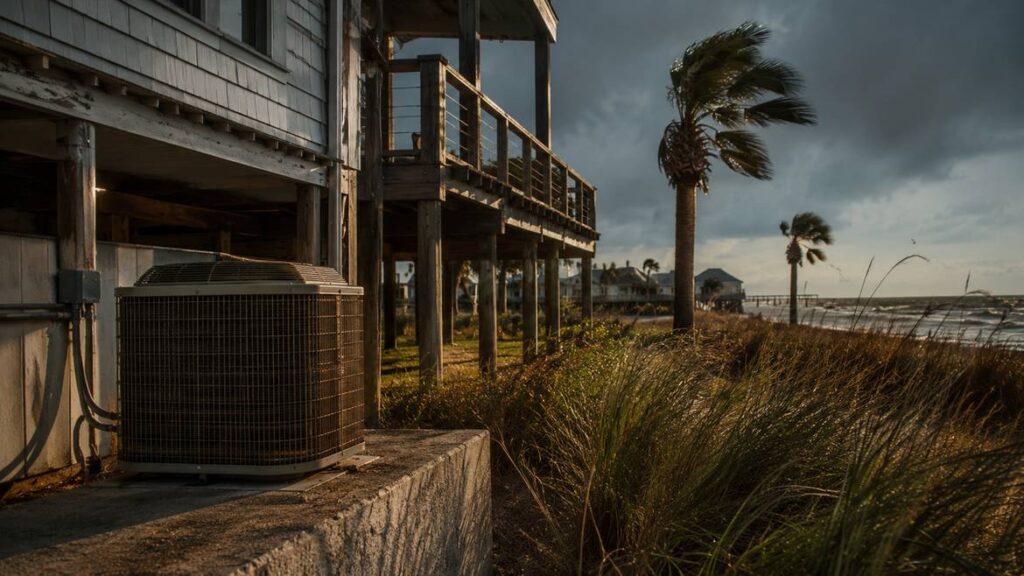
Hurricane season on the Texas coast runs from June 1 through November 30, and Galveston sits in one of the most exposed corners of the Gulf. Salt spray eats coils, storm surge can submerge outdoor equipment in minutes, and high winds find every loose screw on a condenser cabinet. Whether you own a home in Sea Isle or a restaurant on The Strand, your HVAC system is one of the first things to fail in a bad storm, and one of the most expensive to replace.
This is the checklist the team at Coastal Comfort works through with Galveston property owners every spring. Working through it before the next named system enters the Gulf will save you thousands and give you cool air back sooner once the power returns.
Why Galveston HVAC Systems Are in a Class of Their Own
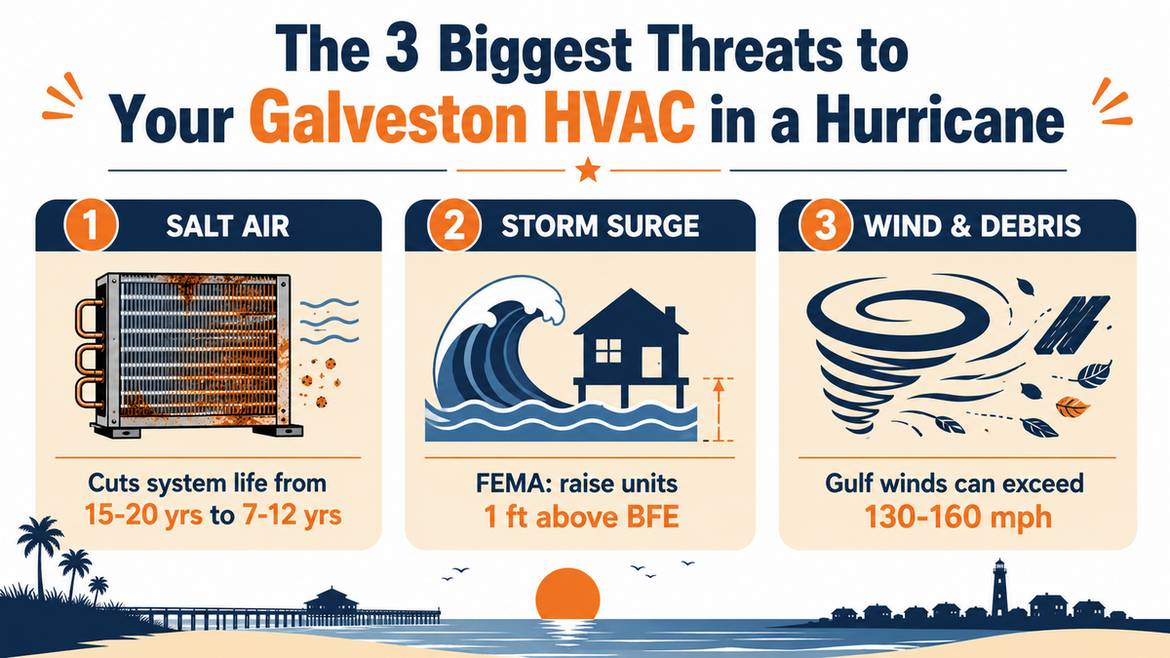
Three forces converge on every condenser, air handler, and rooftop unit on the island, and every one of them is amplified during hurricane season.
Salt air. Constant sea-breeze exposure drives chloride ions into copper coils, aluminum fins, steel cabinets, and every fastener holding them together. Industry data from coastal contractors puts the useful life of an unprotected HVAC system in a coastal climate at 7 to 12 years, compared with 15 to 20 years inland. Storms concentrate that damage into a single event by driving salt-laden spray miles inland.
Storm surge and flooding. FEMA’s coastal construction guidance recommends that mechanical equipment in Zone V be elevated at least one foot above the Base Flood Elevation (BFE). Standing water and surge destroy motors, contactors, and control boards, and they push salt and silt deep into coil fins and ductwork where you cannot see it.
Wind and debris. Gulf hurricanes commonly produce sustained winds above 100 mph with gusts of 130 to 160 mph. Loose panels, poorly anchored condensers, and unsecured yard items become projectiles that puncture coils, bend fan blades, and rip refrigerant lines.
The Pre-Season Checklist (April and May)
The best time to prepare is before the National Hurricane Center is tracking anything. April and May give you enough runway to schedule inspections, order parts, and pour a hurricane pad if you need one.
1. Book a Full Pre-Season Inspection
A proper coastal inspection is not the same as a spring tune-up. It looks specifically for storm-season failure points: corrosion on contactors, loose anchor bolts, weak refrigerant line straps, clogged condensate drains, and any electrical connection that has started to rust. If it has been more than a year, get on the calendar now. You can book a pre-season inspection through our HVAC maintenance and check-ups service or, for a business, our commercial HVAC service.
2. Tighten Every Fastener You Can See
Walk the perimeter of every outdoor unit. Check cabinet screws, base bolts, mounting brackets, and refrigerant line straps. Replace anything corroded with stainless or coated hardware. In a Category 2 or higher storm, a missing screw on an access panel is the difference between a bent fin and a totaled unit.
3. Elevate the Condenser (or Confirm It Already Is)
If your outdoor unit sits on a thin ground-level pad in a low-lying part of the island, it is a candidate for elevation. FEMA’s benchmark is one foot above BFE, anchored to the structure with corrosion-resistant hardware. Concrete hurricane pads and engineered steel platforms are both acceptable. This is the single biggest upgrade you can make for a home near the bay or the Gulf.
4. Install HVAC-Rated Surge Protection
Lightning and grid instability during a storm will fry a control board faster than water will. Install a whole-home surge protector at the panel and a dedicated HVAC surge device at the condenser and air handler. Cost is minor, protection is significant.
5. Rinse the Coils and Clear the Perimeter
Coastal contractors recommend rinsing outdoor coils gently with a garden hose one to two times per month during heavy salt-spray periods. Use low pressure, no pressure washer. Keep a 2 to 3 foot clear perimeter around every outdoor unit, and cut back any tree limb that could fall on it in a wind event.
6. Check Ductwork and Attic Insulation
Salt-laden moisture rides through attic vents and roof leaks straight into your ductwork, where it causes hidden corrosion and mold. Reseal duct joints with mastic or approved foil tape (never cloth duct tape) and repair wet insulation before storm season. Our indoor air quality guide covers what to watch for.
The 72-Hour Pre-Storm Checklist
Once the National Weather Service Houston/Galveston office (weather.gov/hgx) issues a hurricane watch for Galveston County, or the Galveston Office of Emergency Management (GOEM) is briefing on possible impacts, move into storm mode.
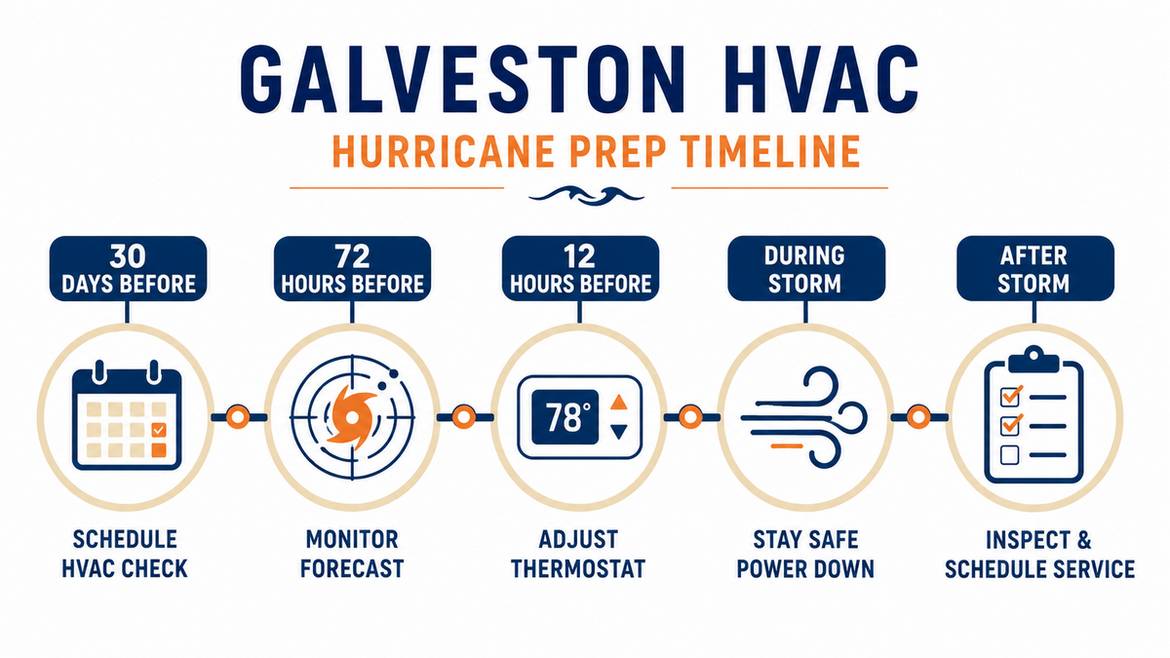
72 hours out
- Confirm your evacuation zone at galvestoncounty.gov/oem and plan accordingly.
- Verify that all outdoor unit straps and anchors are tight.
- Charge your phone, note the number of your HVAC contractor, and take date-stamped photos of every unit for insurance.
- If you manage a rental property, notify guests and coordinate with your property manager. Our vacation rental owners program covers pre-storm walkthroughs for absentee owners.
24 to 48 hours out
- Move grills, patio furniture, potted plants, and tools indoors or into a garage. Anything within throwing distance of a condenser becomes a projectile.
- Change your air filter so the system runs clean when power is restored.
- Re-check the 2 to 3 foot perimeter around each outdoor unit.
12 hours out
- Pre-cool the home. Drop the thermostat 3 to 5 degrees below normal (typically down to 68 to 70 degrees) so the interior holds temperature longer after shutdown.
- Turn the HVAC OFF at the thermostat, then OFF at the breaker. This is critical. Shutting off at the breaker protects the compressor and control board from voltage sags, spikes, and the rolling on-off cycles that happen when the grid destabilizes.
- Remove window AC units so windows can be fully closed and sealed.
- Cover the outdoor condenser with a tarp or plywood secured with bungee cords ONLY after power is off. Leave vent gaps so trapped moisture can escape. Never use screws or drilled fasteners on the cabinet.
During the Storm
Do not turn the HVAC back on. Do not go outside to check on the unit. Wind, lightning, and flying debris are the real risk, and there is nothing you can do for the equipment during the event. Stay inside, follow GOEM instructions, and wait for the all-clear.
The Post-Storm Restart Checklist
The most expensive mistake we see after a storm is flipping the breaker back on before anyone has looked at the equipment. Do not do this. Water damage and salt contamination can short a compressor the instant you power up, and that turns a $600 service call into a full system replacement.
1. Visual Inspection Before You Touch the Breaker
Once conditions are safe, walk out and look. Signs to stop and call a technician:
- Standing water at or above the base of the condenser
- Missing or bent cabinet panels
- Bent fan blades or visible impact damage
- Any signs of flooding at the indoor air handler or electrical disconnect
- A high-water line on the exterior of the unit
If the unit was submerged, even briefly, DO NOT restart. Salt and silt inside the electrical compartment will destroy it on first startup.
2. Clear Debris and Rinse Salt
Remove leaves, branches, roofing material, and shingles from the top and sides of the condenser. Rinse coils gently with a garden hose to flush storm-driven salt and sand, avoiding the electrical compartment. This step matters most in the 24 to 48 hours after the storm, before salt has time to set.
3. Book a Post-Storm Inspection
A licensed technician needs to check refrigerant pressures, electrical continuity, condensate drainage, cabinet integrity, and the control board before the system is restarted. If your unit shows any of the warning signs above, call our 24/7 emergency HVAC line. We prioritize post-storm calls across Galveston County.
4. Inspect Ducts, Attic, and Air Handler
Roof damage is common in Galveston storms, and even small breaches funnel water into attic ductwork. Look for wet insulation, disconnected duct sections, and any signs of water at the air handler. Wet duct insulation must come out quickly; if it stays in place, it becomes a mold problem within days in Galveston humidity.
Commercial HVAC: What Business Owners Should Add
Restaurants, retail, and mixed-use buildings on Galveston Island have exposures that homeowners do not.
Rooftop units and package systems are the most vulnerable pieces of equipment on any commercial building. They take the full brunt of wind and are difficult to inspect after a storm. Before hurricane season, verify curb anchoring, gasket integrity, and that no rooftop gravel or loose flashing can become projectiles.
Walk-in coolers and freezers at restaurants and hotels are on their own clock during a power outage. Have a generator or spoilage plan documented before the storm. Our walk-in cooler and freezer service team can pre-inspect gaskets and controls in April and May.
Commercial ice machines need to be shut down at the breaker and drained before landfall. Restart requires a filter change and a full sanitation cycle to be safe for guests. See our commercial ice machine repair page for the pre-storm shutdown steps we walk restaurants through.
Documentation. Your insurance carrier will require date-stamped photos taken before the storm and a formal inspection report before authorizing HVAC-related claims. Build this into your annual hurricane plan, not your post-storm scramble.
A Quick Word on Salt-Air Corrosion
Hurricane prep is not the only reason salt management matters. It is the reason a Galveston Island HVAC system fails at 7 years instead of 15. If you are replacing equipment this year, spec a coastal-rated model with factory-applied protective coatings and stainless hardware. It is a 3 to 8 percent upcharge that pays back in years of additional service life. Talk to our team about your options through our HVAC installation service.
Local Galveston Resources to Bookmark
- Galveston Office of Emergency Management (GOEM): galvestoncounty.gov/oem for evacuation zones, alerts, and county updates.
- National Weather Service, Houston/Galveston Forecast Office: weather.gov/hgx for the official local forecast, watches, and warnings.
- FEMA Coastal Construction Manual: the standard for elevating mechanical equipment in Zone V. Search “FEMA P-2181 Fact Sheet 3.4.1 HVAC” for the current guidance.
- Coastal Comfort 24/7 line: (409) 202-2188 for pre- and post-storm HVAC support across Galveston Island, Tiki Island, Jamaica Beach, Bayou Vista, League City, Freeport, and the surrounding coast.
Ready for the Season
Hurricane prep is not a one-weekend project. It is a series of small, cheap steps taken in the right order that add up to a system that survives the storm and cools your home again the day after power is restored. If you have not booked a pre-season inspection yet this year, do it now, before the first named storm enters the Gulf.
Call Coastal Comfort at (409) 202-2188 or reach out through our contact page to get on the schedule. We are locally owned, licensed, and on the island every day of the year, hurricane or not.
Frequently Asked Questions
When does hurricane season officially start in Galveston?
Atlantic hurricane season runs from June 1 through November 30, with peak activity from mid-August through late October. Your HVAC prep should be complete by late May.
Should I cover my outdoor AC unit during a hurricane?
Yes, but only after the system is shut off at the breaker, and only with a breathable tarp or plywood secured with bungee cords. Never use screws or drilled fasteners. Leave gaps so trapped moisture can escape.
How high should my condenser be elevated?
FEMA recommends at least one foot above the Base Flood Elevation (BFE) for equipment in coastal Zone V. On low-lying Galveston lots and homes near bay or Gulf frontage, higher is better. The platform must be anchored to the structure with corrosion-resistant hardware.
Can I turn my AC back on right after the storm passes?
Not before a visual inspection. If the unit was submerged, was hit by debris, or shows any electrical damage, do not restart it. Call a licensed HVAC technician for a post-storm inspection first. Restarting a compromised unit is how a repair becomes a replacement.
What if my rooftop unit was damaged during a storm?
Do not attempt a rooftop inspection yourself, especially with wet decking and possible structural damage. Book a commercial post-storm inspection so a licensed technician can assess curb anchoring, cabinet integrity, and refrigerant pressures safely.
Does homeowners insurance cover HVAC hurricane damage?
Coverage varies by carrier and policy. Wind damage is typically covered, while flood damage requires separate flood insurance. Documenting pre-storm condition with date-stamped photos and a recent inspection report is the single most important thing you can do to support a claim.