
If you own an older Galveston home, chances are it was never built with ductwork. Beach cottages, historic East End bungalows, and stilted West End houses often rely on window units, aging wall shakers, or a patchwork of portable ACs to get through the summer. When it is finally time to modernize, you land on the same fork in the road every islander faces: install a full central air system with brand new ducts, or go ductless with a mini-split.
The right answer depends on your home, your budget, and how you feel about salt air chewing through metal. In most cases we see at Coastal Comfort, ductless mini-splits win the value comparison for Galveston homes without existing ductwork. But central air still has real advantages if you are already deep into a renovation or you value hidden equipment.
Why This Choice Is Different in Galveston
Two things separate our island from the rest of Texas when you are picking an HVAC system: the age of the housing stock and the salt air.
A large slice of Galveston’s residential inventory was built before central air became standard. Many East End Historical District homes date to the late 1800s and early 1900s, and stilted West End homes were often designed for cross-ventilation, not ducted air. Cutting new duct runs through plaster walls, coved ceilings, and hand-built trim is invasive, expensive, and sometimes impossible without damaging the character that makes those homes worth preserving.
Then there is the Gulf. Salt aerosol and humidity attack HVAC equipment three to five times faster within a mile of the water than they do inland. Field studies in the Galveston environment have measured aluminum fin pitting reaching 19 to 22 percent of material thickness after just one year of exposure, with capacity losses of 4 to 5 percent on the sensible side and up to 20 percent on the latent (dehumidification) side. Standard galvanized condenser cabinets installed near the seawall can rust through in three to five years. A system that would last 15 to 20 years inland often makes it only 5 to 7 years on the island without proper protection.
Whichever system you choose, salt air is going to matter more than efficiency ratings.
The Cost Reality: Installed Prices in Galveston
The single biggest driver of this decision, for a home without existing ductwork, is the cost of adding those ducts. Here is what the current market looks like for Galveston-area installs with corrosion-rated equipment.
Ductless Mini-Split Installed Costs
- Single-zone system (one outdoor unit, one indoor head, roughly 9,000 to 18,000 BTU/h): $3,000 to $5,500
- Two- to three-zone system (24,000 to 36,000 BTU/h total): $8,000 to $12,000
- Four-plus zones or premium high-SEER2 inverter systems: $12,000 to $15,000+
For a typical three-bedroom Galveston home needing three to four zones, plan on $10,000 to $15,000 installed with corrosion-rated equipment. Stilted homes with long line-set runs and complex electrical work often skew toward the top of that range.
Central Air With New Ductwork
If the home has no ducts, you are paying for the equipment plus a full ductwork build-out.
- Ductwork alone in an older home: adds $3,000 to $8,000, often more when soffits, chases, and finish repairs are required.
- Total central AC system with new ducts: commonly runs $15,000 to $25,000+, depending on layout complexity.
The equipment itself is not the expensive part. Cutting into walls and ceilings, framing chases to hide trunk lines, patching plaster, and repainting rooms is where the money goes. In a historic Galveston home, the work can be even more expensive because trim, wainscoting, and antique flooring often have to be carefully removed and reinstalled.
Operating Costs and Efficiency
Once installed, mini-splits typically cost less to run than a comparable central system, particularly in a home where new ducts would run through hot attics.
Independent comparisons put typical annual operating costs at roughly $200 to $400 per year for mini-splits versus $300 to $600 per year for central air. On a 2,000-square-foot home, central AC can add $100 to $150 per month to peak-summer electricity bills. Homeowners switching from central to ductless commonly report 20 to 30 percent bill reductions, with payback windows of 3 to 8 years in the ductless case versus 8 to 12 years for central retrofits.
There are two reasons ductless wins here. First, modern inverter-driven mini-splits reach very high SEER2 ratings, often in the high teens to mid-20s. Second, they eliminate the 20 to 30 percent duct losses that plague ducted systems, especially when ducts sit in a 130-degree Galveston attic.
SEER2 Ratings and What They Mean for Rebates
SEER2 (Seasonal Energy Efficiency Ratio 2) is the current federal efficiency standard, and it matters for two reasons in Galveston: monthly power bills and rebate eligibility.
For CenterPoint Energy rebate eligibility on split and mini-split systems in 2025, the minimums are:
- 15.2 SEER2 minimum cooling efficiency
- 10 EER2 minimum energy efficiency ratio
- 7.5 HSPF2 minimum heating efficiency (for heat pumps)
- Up to 65,000 BTU/h system capacity
For the federal Section 25C tax credit, the bar is higher: the system must meet the Consortium for Energy Efficiency (CEE) Highest Tier thresholds for ductless heat pumps and be listed as ENERGY STAR Most Efficient for the applicable year. The manufacturer must also be registered with the IRS and provide a Qualified Manufacturer Identification Number (QMID) so you can claim the credit on Form 5695.
Choose equipment that clears the ENERGY STAR Most Efficient bar and you get both the CenterPoint incentive and the federal credit.
CenterPoint Energy and Federal Incentives in 2025 to 2026
Galveston is inside CenterPoint Energy’s electric distribution territory, so you have access to their residential HVAC rebate programs. Federal tax credits stack on top.
CenterPoint Rebates
Through CenterPoint’s Midstream HVAC & Heat Pump Water Heater Program and Standard Offer Program, expect:
- At least $200 passed through for qualifying AC or mini-split systems
- At least $400 passed through for qualifying heat pumps (including ductless heat pumps)
- Up to $500 per qualifying heat pump unit through the Standard Offer Program
- Around $75 for qualifying smart thermostats installed with the system
Ask any contractor giving you a quote whether they participate in CenterPoint’s programs and require the rebate pass-through to appear as a line item on the invoice.
Federal Section 25C Tax Credit
The Inflation Reduction Act extended the Section 25C credit through 2032. For qualifying ductless mini-split heat pumps:
- 30 percent of qualified project costs
- Capped at $2,000 per year for air-source heat pumps
- Claimed on IRS Form 5695 for the year the system is placed in service
For a $5,500 single-zone install that hits the efficiency thresholds, 30 percent is $1,650 in credit. On an $11,000 three-zone system, you hit the $2,000 cap. Combined with the CenterPoint rebate, total incentives commonly reduce project costs by 20 to 40 percent.
Salt-Air Considerations You Cannot Skip
This is the section that separates a good Galveston HVAC decision from an expensive mistake.
Corrosion Protection Is Not Optional Near the Gulf
Standard equipment, whether central or ductless, is at high risk of premature failure in coastal Galveston. Coastal contractors describe standard ductless outdoor units mounted within a mile of the Gulf as operating at roughly 50 percent capacity after only three years due to fin corrosion and coil damage.
The right specifications:
- Corrosion-rated outdoor units: $300 to $800 more than standard, but typically last 2 to 3 times longer in salt air
- Factory-applied protective coatings: Heresite, Electrofin, or Insitu treatments add $200 to $500 to equipment cost and can add 3 to 7 years of life in severe exposure zones
- Marine-grade cabinets and stainless hardware: units tested to ASTM B117 salt spray standards (1,000-hour exposure with no base metal corrosion)
- Copper or e-coated aluminum fins and protected electrical connections
Specify these on any quote. If a contractor pushes back or shrugs, get another quote.
Mini-Splits Versus Central Air in Salty Conditions
Both system types can survive Galveston with the right protection, but they present different risks.
- Central air has a single, larger outdoor condenser: one unit to coat, cage, and rinse. Simpler to protect, but concentrates risk in one piece of equipment. Long duct runs and plenums also add hidden metal surfaces where corrosion can attack, especially in humid attics.
- Mini-splits typically have multiple smaller outdoor units (or one multi-zone condenser with multiple line sets), each with its own coil and electrical components. More surfaces to protect, but a multi-zone setup on a single outdoor unit consolidates the exposure.
Neither is inherently better in salt air. The specification of the equipment and the placement decisions matter far more than the system type.
Placement and Maintenance
Practical rules for either system type on Galveston Island:
- Locate outdoor units on the leeward side of the home when possible, away from prevailing sea spray.
- Elevate condensers on corrosion-resistant stands. Flood zones make this doubly important.
- Rinse outdoor coils with fresh water every 2 to 4 weeks during salty summer months, more often after windy days.
- Replace filters more frequently. Salt, sand, and airborne particles clog them faster than inland conditions.
- Schedule at least annual (and ideally biannual) professional maintenance, with a specific salt-air inspection focus.
- Seal wall penetrations and protect exposed line sets to prevent moisture intrusion at fittings.
For older Galveston homes, our team offers routine HVAC maintenance and check-ups built specifically for coastal conditions.
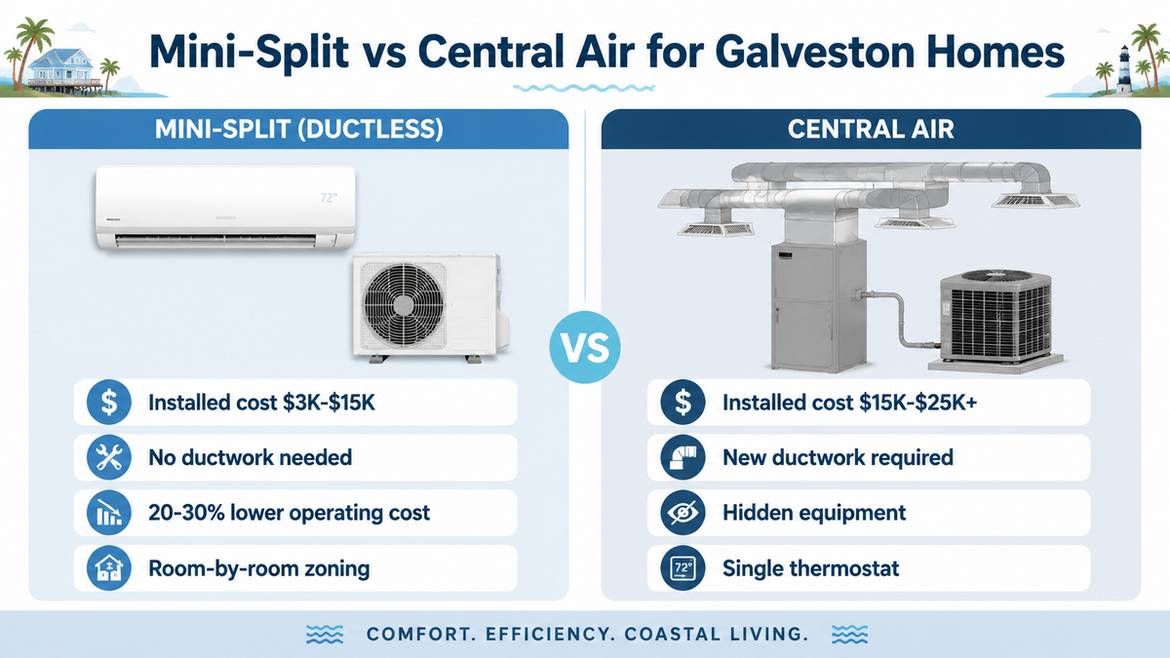
Pros and Cons at a Glance
Ductless Mini-Splits
Advantages
- No ductwork required, avoiding $3,000 to $8,000 in retrofit costs
- Preserves historic finishes and trim in older Galveston homes
- 20 to 30 percent lower operating costs than central air
- Room-by-room zoning for uneven cooling loads (upstairs bedrooms, sunrooms, additions)
- Well-suited to stilted West End homes with limited attic and wall cavities
- High-efficiency inverter models qualify for maximum CenterPoint and federal incentives
Trade-offs
- Visible wall or ceiling cassettes indoors
- Higher per-zone equipment cost when many rooms need conditioning
- Multiple indoor filters and drain pans to service
Central Air With New Ducts
Advantages
- Hidden equipment, traditional registers, single thermostat
- Widely familiar to buyers, potentially slightly better perceived resale value
- Cost-competitive when you are already doing a full gut renovation that includes ducts
Trade-offs
- Very high retrofit cost ($15,000 to $25,000+) for homes without ducts
- Requires significant demolition and finish repair
- Duct losses in hot attics reduce real-world efficiency
- Fewer zoning options without added dampers and controls
A Practical Decision Framework
Use these quick tests to point yourself toward the right answer:
Lean ductless if:
- Your Galveston home has no existing ducts and you are not otherwise gutting it
- You want lower monthly bills and a faster payback (3 to 8 years)
- You value zoning for guest rooms, upstairs bedrooms, or additions
- You are comfortable with visible indoor units
- You want to maximize CenterPoint and federal tax credit incentives on a single project
Lean central air if:
- You are already planning a major renovation that includes ductwork anyway
- You strongly prefer hidden equipment and a single thermostat
- You are prepared to invest $15,000 to $25,000+ and manage significant construction
- Resale to a broad buyer pool is a top priority
Whole-Home Example: A Three-Bedroom East End Bungalow
Consider a 1,600-square-foot East End home with no existing ductwork, three main zones needed (living/kitchen, primary bedroom, upstairs bedrooms), and full salt-air exposure four blocks from the seawall.
Option A: Three-zone corrosion-rated ductless mini-split
- Installed cost with corrosion-rated equipment: ~$11,000
- CenterPoint heat pump rebate: ~$500
- Smart thermostat rebate: ~$75
- Federal Section 25C tax credit: $2,000 (capped)
- Estimated net cost: ~$8,425
- Annual operating cost estimate: $250 to $400
Option B: Central AC with new ductwork
- Installed cost with corrosion-rated condenser: ~$20,000
- CenterPoint rebate: ~$200 to $500
- Federal tax credit: possible, model-dependent
- Estimated net cost: ~$17,000 to $19,000
- Annual operating cost estimate: $400 to $600
The mini-split option costs roughly half as much and saves an estimated $150 to $200 per year in operating costs, all while avoiding a lengthy demolition project inside a historic home.
How Coastal Comfort Approaches This on the Island
Coastal Comfort has been keeping Galveston-area homes and businesses cool since 1954 (originally as Townley Refrigeration). For older homes without ductwork, we walk through each home before quoting to check attic access, wall cavity depth, historic finish sensitivity, and salt exposure. Our default is to specify Trane corrosion-rated equipment with factory-applied coil coatings for any install within a mile of the water.
If you want to see how we handle installs specifically:
- Our full HVAC installation service page covers both ducted and ductless
- The Galveston Island service area page has the specifics for island homes
- Our post on why we install Trane explains our equipment approach
- For rental owners, our vacation rental owners service covers scheduled maintenance around bookings
Next Steps for Galveston Homeowners
The right HVAC choice for an older Galveston home almost always starts with an in-person walk-through. We look at what the home is telling us: how the sun hits it, where the wind carries salt, how the interior finishes will handle any construction, and where a condenser can live safely.
If you are weighing mini-split versus central air for your Galveston home without ductwork, call Coastal Comfort at (409) 202-2188 or contact us online for a walk-through and a written quote. We will map out your options, spell out the CenterPoint rebates and federal credits you qualify for, and give you a straight answer about what actually makes sense for your home.

Frequently Asked Questions
Are ductless mini-splits better than central air in Galveston?
For homes without existing ductwork, mini-splits are usually the better value in Galveston. They avoid the $3,000 to $8,000 duct retrofit cost, run 20 to 30 percent cheaper on operating cost, and support room-by-room zoning. Central air still makes sense if you are already installing ducts as part of a larger renovation.
How much does a mini-split cost for a Galveston home?
Installed costs with corrosion-rated equipment typically run $3,000 to $5,500 for a single-zone system and $8,000 to $15,000 for a three- to four-zone whole-home system. Stilted homes with long line sets can push toward the top of those ranges. After CenterPoint rebates and the federal Section 25C tax credit, homeowners often save 20 to 40 percent off the sticker price.
What SEER2 rating do I need to get the CenterPoint rebate?
CenterPoint’s 2025 program requires a minimum of 15.2 SEER2, 10 EER2, and 7.5 HSPF2 (for heat pumps) on split and mini-split systems up to 65,000 BTU/h. For the federal tax credit, you typically need to exceed those thresholds and meet ENERGY STAR Most Efficient status.
Will salt air destroy my new HVAC system?
Not if you specify the right equipment. Corrosion-rated outdoor units, factory-applied coil coatings (Heresite, Electrofin, or Insitu), stainless hardware, and thoughtful placement can extend equipment life 2 to 3 times over standard units on the island. Plan on freshwater rinses every 2 to 4 weeks in summer and biannual professional maintenance.
Can I install a mini-split in a historic East End Galveston home?
Yes, and it is often the best choice for historic homes. Small refrigerant lines and cables can be routed through exterior walls with minimal demolition, preserving plaster, trim, and original finishes. Indoor cassettes can be positioned discreetly, and slim ceiling recessed units are available if wall placement is a concern.
How long will a properly specified mini-split last on Galveston Island?
With corrosion-rated equipment, quality coil coatings, and a consistent salt-air maintenance plan, expect 12 to 15 years of reliable service. Standard, unprotected equipment can fail in 5 to 7 years in the same environment, so the upfront investment in coastal-grade specifications pays back through fewer replacements.